Valve's monthly hardware surveys have long served as a definitive barometer for the overall state of the PC industry. The latest data from June illustrate how global volatility in the component market and resource shortages are directly impacting the end-user experience. At the heart of these findings is a memory crisis that has pushed users to adopt a more pragmatic approach to their upgrade cycles. This shift reflects a broader trend toward cautious consumption, driven by the instability of pricing for both storage drives and RAM.
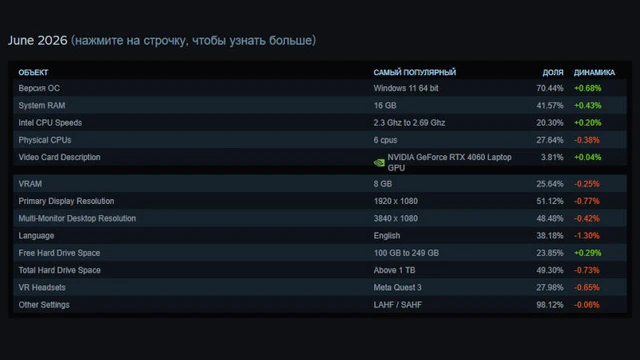
The contemporary hardware market is experiencing significant volatility, a trend clearly mirrored in Steam's June statistics. The most concerning dynamics are evident in the storage segment: the share of players utilizing SSDs larger than 1 TB has dipped by 0.7 percentage points, falling below the psychological threshold of 50% for the first time. Simultaneously, mid-range drives (750 to 999 GB) have seen a surge in popularity, now accounting for 24.75%. This shift suggests a pivot away from high-capacity solutions, likely driven by price spikes or supply chain constraints.
A similar trend toward "rationalization" is apparent in RAM capacities. The 16 GB standard has firmly established itself as the new norm, increasing its footprint to 41.57%. Meanwhile, the 32 GB and 64 GB segments have seen slight declines. This indicates that a substantial portion of the audience views 16 GB as sufficient for most modern workloads, eschewing over-provisioning in a climate of economic uncertainty.
In contrast to the memory crunch, the CPU segment is undergoing a robust evolution toward multi-threading. The share of traditional 6-core CPUs has receded to 27.64%, while interest in more powerful alternatives continues to climb. Positive growth is evident across all categories exceeding 8 cores—from mainstream 8-core chips to high-performance 14- and 16-core systems. This suggests that gamers are prioritizing investments in raw compute capacity, even while trimming budgets for memory.
Graphics accelerators are also undergoing an organic upgrade cycle. Legacy GPUs with 2 to 4 GB of VRAM, which currently hold about 12% of the market, continue to lose ground. They are being replaced by more modern architectures; most notably, the 16 GB VRAM segment has grown to 24.50%. There is also a noticeable influx of users into the 6 GB and 12 GB categories, confirming the escalating VRAM demands of contemporary titles.
The software ecosystem and visual standards remain relatively stable, though subtle shifts are emerging. Windows' dominance has strengthened, reaching 70.44%, with Windows 10 gradually losing ground to newer OS versions. Linux, despite its niche status, saw a marginal decline to 3.69%. Regarding display resolutions, Full HD (1080p) maintains its lead at 51.12%, yet there is steady growth in the popularity of QHD (2560 × 1440) and specialized formats such as 2560 × 1600.
Completing the picture is a global demographic pivot within the user base. While English remains the primary language for 38.18% of players, its influence is slowly waning. Conversely, the Chinese market is expanding rapidly: the share of users utilizing Simplified Chinese has climbed to 24.19%, making it the second most popular language on the platform. Against this backdrop, a moderate decline in Spanish- and Russian-speaking users underscores a shift in the gaming industry's center of gravity toward the Asia-Pacific region.
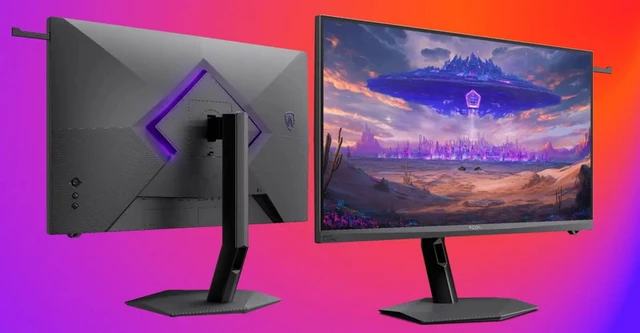 The Pinnacle of Clarity: AOC's New 5K Monitor