The pursuit of full reusability has emerged as the defining challenge of modern astronautics, fundamentally reshaping the economics of orbital access. SpaceX’s Starship program embodies this ambitious vision, treating every launch as a large-scale stress test designed to push materials to their absolute breaking point. The recent successful recovery of the upper stage from the Indian Ocean marks a pivotal shift: moving away from an era of controlled destruction toward a phase of rigorous forensic analysis of surviving systems. This operation provides unprecedented data on the performance of the thermal protection system under the actual conditions of atmospheric reentry.
In the contemporary aerospace landscape, success is no longer defined solely by achieving a target orbit, but by the capacity for a system to return to its point of origin for rapid reuse. It is for this reason that the news of the 52-meter Starship being successfully loaded onto a semi-submersible transport vessel in the Indian Ocean is of fundamental importance. After a month in open water, the gargantuan structure is now embarking on a multi-month journey back to Starbase in Southern Texas.
The thirteenth test flight marked a pivotal milestone in the system's evolution. The ship fulfilled its primary objective, deploying a batch of 20 next-generation Starlink (V3) satellites into orbit. However, from a technical standpoint, the more significant achievement was the validation of a Raptor engine's operation in the vacuum of space—a critical capability essential for future lunar and Martian expeditions.
The mission culminated in a soft splashdown off the coast of Western Australia. Unlike previous iterations, where vehicles either incinerated in the dense layers of the atmosphere or disintegrated upon impact, this Starship remained largely intact. Conversely, the first stage—the Super Heavy booster—encountered more severe complications; a propulsion system failure resulted in a hard impact with the surface of the Gulf of Mexico.
For SpaceX, this incident presented a rare and invaluable opportunity. Rather than abandoning the craft to the ocean, engineers opted for a comprehensive forensic analysis of the materials. The primary focus was the thermal protection system—a complex array of ceramic tiles designed to withstand the colossal temperatures of hypersonic reentry. Understanding exactly how the shield weathered thermal loads and the mechanical impact of plasma allows for the optimization of tile composition and mounting methods in subsequent versions of the spacecraft.
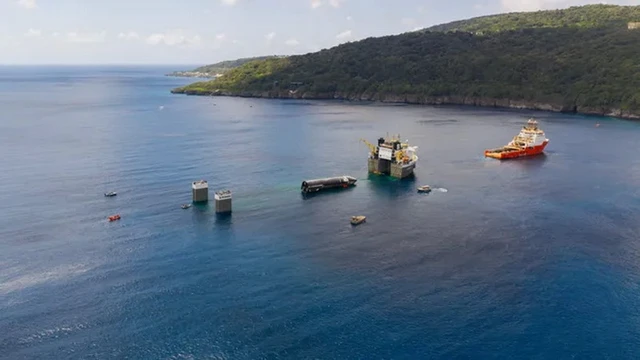
The recovery operation proved to be a formidable logistical challenge. The ship was towed to Christmas Island, an Australian territory located approximately 1,900 km northwest of the town of Broome. Over several days, a team of specialists conducted an on-water inspection of the structure, collecting material samples and documenting any structural deformations.
The final phase of the operation involved loading the craft onto a specialized semi-submersible vessel. The engineering behind such transport is impressive: the ship is capable of partially submerging its deck, allowing the floating object to "float" aboard, after which the deck is raised, securing the cargo safely above the waterline.
This episode underscores SpaceX's iterative philosophy: the successful recovery of a system component yields more actionable data than hundreds of hours of computer modeling. As Starship makes its way back to Texas, the insights gained regarding the state of the thermal protection system will serve as the foundation for designing future fully reusable architectures, capable of performing hundreds of flights without requiring a complete overhaul.
 The Carbon Breakthrough in Semiconductor Manufacturing