Last-mile logistics remains one of the most complex and cost-intensive bottlenecks in modern delivery chains. Conventional wheeled robots and drones frequently falter when faced with everyday obstacles like staircases or the unpredictable terrain of suburban environments. Boston Dynamics is challenging this status quo by leveraging the superior agility of Spot, its quadrupedal robot. This strategic pivot evolves the autonomous machine from a high-profile tech showcase into a pragmatic instrument for operational optimization.
The "last mile" challenge—the final leg of a journey from the distribution hub to the customer's doorstep—has long been a persistent bottleneck for the e-commerce industry. Despite the aggressive deployment of wheeled platforms and drones, the realities of the urban landscape—curbs, narrow corridors, and staircases—often prove insurmountable for most existing robotics. In this environment, the human element remains indispensable, yet it comes with significant drawbacks: high physical strain on couriers and limited order processing speeds.
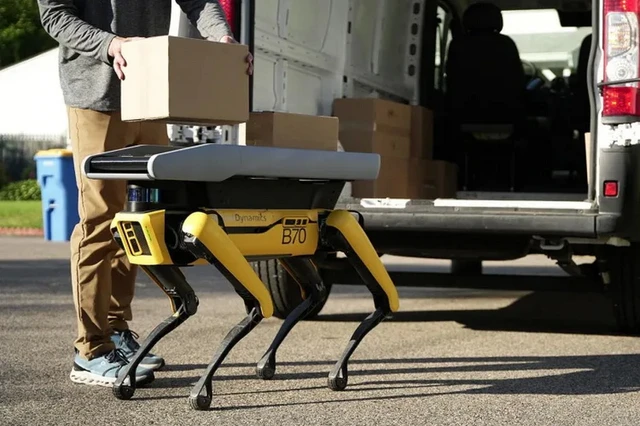
The solution to this dilemma may lie in integrating Spot, the quadruped robot, into the delivery chain. Unlike wheeled systems, Spot's biomorphic design allows it to navigate the unstructured terrains typical of suburban and urban environments with confidence. To transform this research-grade robot into a functional delivery agent, a specialized compact conveyor system has been developed. This mechanism enables the machine to autonomously and precisely offload packages directly at the customer's threshold, minimizing the need for human intervention during the final stage.
The operational workflow is streamlined: a courier transports the cargo as close to the destination as possible before deploying Spot from the vehicle. The robot then accepts several parcels and distributes them across neighboring addresses, overcoming obstacles that would immobilize a conventional delivery bot. This synergy between human and machine optimizes the driver's productivity; while Spot completes the current delivery, the courier can focus on preparing the next batch of goods or optimizing routing.
It is worth noting that Spot's adaptation for logistics leverages its pedigree in hazardous environments. These robots have already proven their worth in search-and-rescue operations and rubble clearance, where the ability to traverse chaotic terrain is critical. Translating these competencies into the civilian delivery sector transforms Spot into a versatile assistant capable of operating where standard automation fails.
However, large-scale adoption faces a significant economic hurdle. With a unit cost of $75,000, Spot represents a substantial capital expenditure even for major logistics operators. The economic viability will ultimately depend on how significantly operational costs are reduced through increased courier efficiency and the mitigation of physical labor.
Currently, Boston Dynamics is transitioning from conceptual demonstrations to full-scale pilot projects, engaging in negotiations with the market's largest logistics players. The objective is to evolve Spot from a high-tech novelty into an industry standard, finally solving the problem of physical accessibility in the "last mile."
 Intel’s Strategic Play for Advanced Packaging Supremacy