The modern mirrorless market has entered a phase of maturity, where disruptive revolutions have given way to the art of precision refinement. The Sony Alpha 7 V stands as the quintessential embodiment of this shift, aiming to push the concept of the all-purpose full-frame tool to its absolute zenith. In an era where the boundaries between photographer and videographer have completely dissolved, a camera is no longer defined by a mere spec sheet; it has evolved into an intelligent interface bridging the creator and their reality. This is a study in how surgical technological enhancements can fundamentally transform the user experience.
The digital photography industry has entered a peculiar era: the pace of innovation has plateaued, and competition among market leaders—Sony, Canon, Nikon, and Panasonic—has evolved into a game of incremental refinement and closing competitive gaps. The previous iteration, the Alpha 7 IV, became the gold standard for versatility, handling the vast majority of professional requirements. The new version doesn't attempt to reinvent the wheel; instead, it focuses on ensuring that the mechanism turns with absolute precision.
Visually, the camera maintains a sense of continuity, but beneath the familiar chassis lies a significant technological overhaul. The pivotal change is the introduction of a partially stacked Exmor RS CMOS sensor. In the world of sensors, this translates primarily to a radical increase in readout speed—nearly 4.5 times faster than its predecessor. For the professional, this isn't just a spec-sheet statistic; it is a direct solution to the "rolling shutter" effect. Vertical lines now remain stable during panning, and the electronic shutter operates with significantly greater clarity.
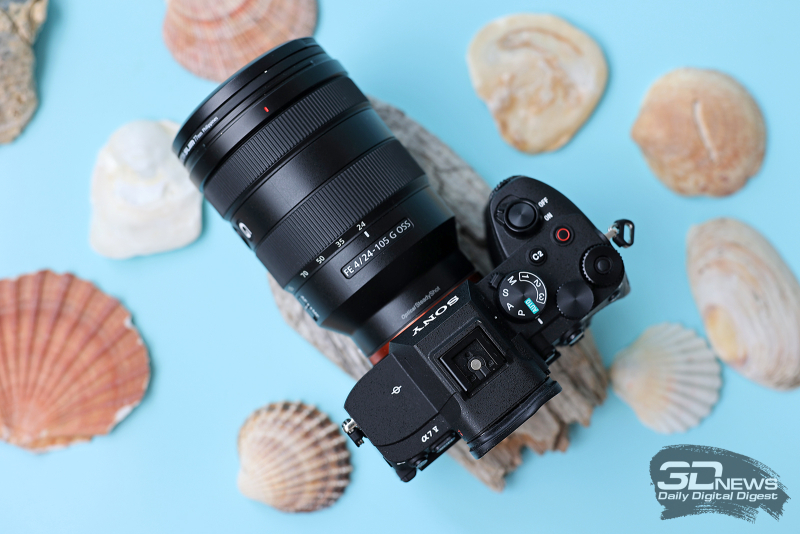
The camera's intellectual hub is now powered by the BIONZ XR2 processor, featuring an integrated machine learning module. While AI functions previously required a dedicated chip, they are now woven into the core architecture, accelerating autofocus performance and expanding recognition capabilities. The system can now identify six distinct subject types, ranging from humans and animals to insects and aircraft. Particularly noteworthy is the human pose estimation feature—the camera maintains focus on the silhouette even when the face is obscured or turned away, a critical advantage for photojournalism and dynamic action sequences.
Burst shooting speeds have seen a quantum leap: the electronic shutter now delivers up to 30 frames per second. Simultaneously, the viewfinder no longer blacks out, ensuring uninterrupted visual control over the subject. A new pre-capture mode has been introduced, allowing photographers to save frames captured a second before the shutter button is actually pressed—an indispensable tool for wildlife and sports photography. However, this high speed comes with a trade-off: the buffer capacity has decreased, making the use of high-speed CFexpress Type A cards practically mandatory.
The video capabilities of the Sony Alpha 7 V propel it into an entirely different league. The primary grievance of the previous model—the significant crop when recording in 4K 60p—has been completely eliminated. The camera now records this format using the full width of the sensor, oversampling from a 7K resolution to provide exceptional detail and the natural perspective of full-frame optics. For those favoring slow motion, a 4K 120p mode is available (with an APS-C crop), while "Dynamic Active" mode provides gimbal-like stability for exceptionally smooth movement.
One of the most significant engineering victories is the redesigned thermal management system. The camera can now record video for up to four hours without overheating, transforming it from a prosumer tool into a fully capable production instrument for long-form interviews or live broadcasts.
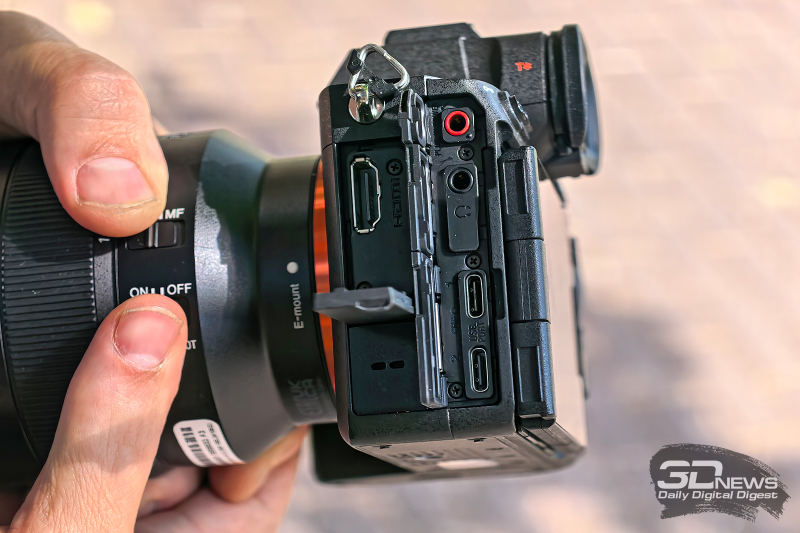
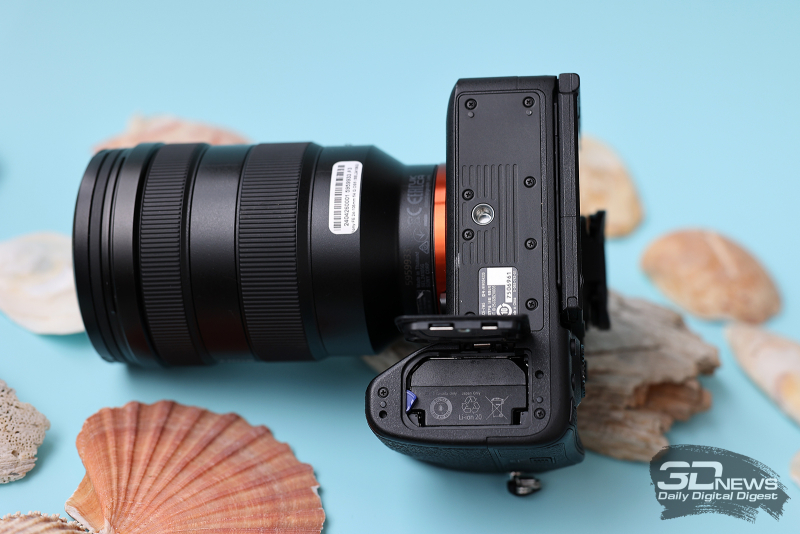
Ergonomics have received targeted but vital improvements. The grip is deeper and more secure, and the display has grown to 3.2 inches. The standout innovation is the hybrid screen mechanism: it now tilts and flips simultaneously, merging the advantages of two different monitoring philosophies. The interface features an optimized menu with color-coded sections, although the overall density of settings remains high—a hallmark of professional-grade equipment.
The port configuration deserves special mention. Sony has implemented dual USB Type-C ports: one dedicated to high-speed data transfer (10 Gbps) and charging, and the other exclusively for peripheral accessories. This allows the camera to be powered by an external source while simultaneously outputting a signal to an external monitor or recorder.

In terms of image quality, the Alpha 7 V demonstrates modest but confident progress. The dynamic range has expanded to 16 stops, providing additional flexibility when recovering deep shadows and bright highlights in RAW files. The introduction of the new RAW HQ format allows for efficient data compression without perceptible loss in quality, optimizing storage on memory cards.
High-ISO performance remains stable; even at ISO 12,800, detail is preserved, and noise maintains a delicate, monochromatic character. AI-driven intelligent white balance now analyzes not only the color temperature of the light but also the content of the scene, resulting in more natural skin tones under challenging mixed-lighting conditions.
Image stabilization has been pushed to 7.5 stops of exposure, enabling sharp handheld shots at long shutter speeds even with telephoto lenses. Combined with the updated Wi-Fi 6 and Bluetooth 5.3 modules, transferring heavy files to mobile devices has become noticeably faster and more stable.
The Sony Alpha 7 V does not strive to be the fastest or the highest-resolution camera in the lineup—those roles are reserved for the a9 and a7R series, respectively. Instead, it serves as the "center of gravity" for the entire family. It is a tool that smooths over the rough edges, removes frustrating limitations, and delivers highly predictable results under any conditions. For owners of the previous generation, upgrading is justified primarily if video production constitutes a significant portion of their workflow or if reportage speed has become a critical factor for success.
 Power and Poise: The Xiaomi Pad 9 Pro Max