The loss of hand motor function resulting from a stroke or neurodegenerative disease transforms the simplest daily tasks into insurmountable barriers. For years, modern rehabilitative medicine has struggled to find a middle ground between prohibitively expensive, cumbersome prosthetics and therapies with limited efficacy. The breakthrough lies in the convergence of soft robotics and artificial intelligence—a synthesis designed to restore fundamental autonomy to the patient. Now, engineers in Munich have unveiled an affordable pneumatic exoskeleton capable of effectively interpreting the user's intentions in real-time.
The challenge of restoring grip functionality in patients with severe central nervous system impairment—such as Amyotrophic Lateral Sclerosis (ALS) or the aftermath of a massive stroke—has long been defined by a tension between high-end functionality and practical accessibility. While traditional robotic prosthetics are undeniably effective, they often remain prohibitively expensive and overly complex for the average patient to operate. A new development from specialists at the Technical University of Munich (TUM) and the Passauer Wolf Rehabilitation Center proposes a fundamental paradigm shift, pivoting toward soft robotics and advanced textile materials.
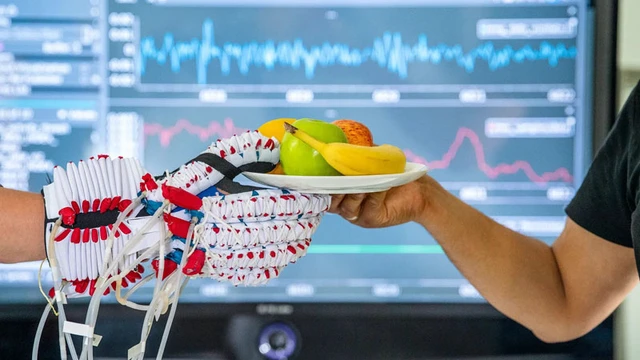
At the core of the device is the concept of a soft exoskeleton. Rather than relying on rigid servo actuators and metallic joints, the system utilizes a lightweight fabric base integrated with a network of pneumatic chambers. Movement is orchestrated via a system of 13 tubes that deliver compressed air to specific segments of the glove, allowing the device to mimic natural physiological motions: flexing and extending the fingers, as well as stabilizing or rotating the wrist.
The developers have placed particular emphasis on the biomechanics of the thumb. In many early exoglove prototypes, the thumb played a merely auxiliary role; however, in this system, its mobility is meticulously engineered. The ability to precisely control abduction and adjust the thumb's positioning is critical for executing various grip types—ranging from a power grip for securing heavy objects to the fine motor skills required for manipulating everyday items. This enables users to independently handle a fork, a glass, or a bottle, radically enhancing their quality of life and personal autonomy.
The system's intelligence is powered by surface electromyography (sEMG). Sensors affixed to the forearm detect even the faintest electrical impulses emitted by the muscles during an attempted movement. Because signals in paralyzed limbs can be extremely weak or "noisy," the system integrates a machine learning algorithm. The AI undergoes preliminary training on patient-specific data, allowing it to recognize human intent with up to 97% accuracy and translate those intentions into precise pneumatic commands.
To ensure grip stability, the glove incorporates additional motion sensors that operate in a closed-loop feedback system. This allows the device to calibrate chamber pressure in real time, preventing objects from slipping and effectively compensating for the patient's lack of natural tactile feedback.
From both a technical and economic perspective, this solution represents a significant leap forward in assistive technology. By replacing complex mechanical assemblies with pneumatics and textiles, the developers have not only reduced the device's weight but also substantially lowered production costs. This paves the way for the mass integration of such systems into rehabilitation practice, making high-tech medical assistance accessible to a much broader demographic of people living with severe motor impairments.
 iPhone 17: Dominating the Global Market