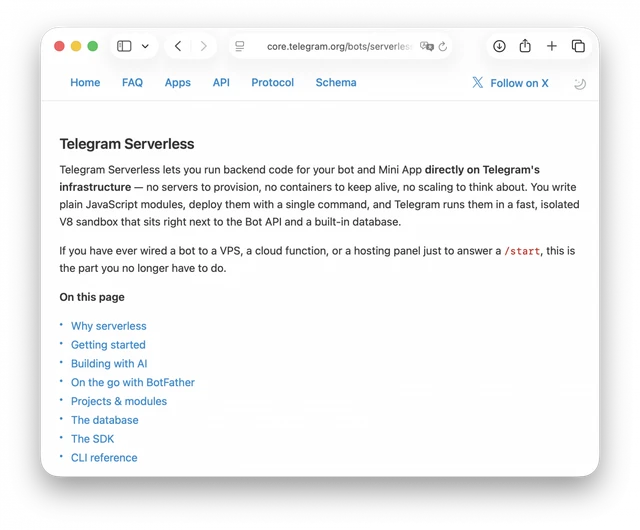
The boundary between a messaging application and a full-fledged operating system continues to dissolve. Telegram’s latest update, which introduces serverless hosting for bots and Mini Apps, represents a fundamental shift in the ecosystem's development paradigm. The platform is transcending its role as a mere communication interface, evolving instead into a robust cloud stack. Strategically, this move solidifies Telegram’s position as the primary hub for the deployment of autonomous AI agents.
Until now, building any sophisticated bot required developers to tackle a classic infrastructural hurdle: renting servers, configuring runtime environments, and ensuring backend fault tolerance. Telegram is radically simplifying this process by allowing application logic to be hosted directly on its own infrastructure. This shift renders external servers optional and delegates the entire application lifecycle management to the platform.
The technical implementation relies on isolated V8 instances—the same engine that powers Google Chrome and Node.js. Code executes within lightweight environments situated in immediate proximity to the messenger's core infrastructure. This architecture minimizes network latency when interacting with the Bot API and databases, ensuring near-instantaneous response times.
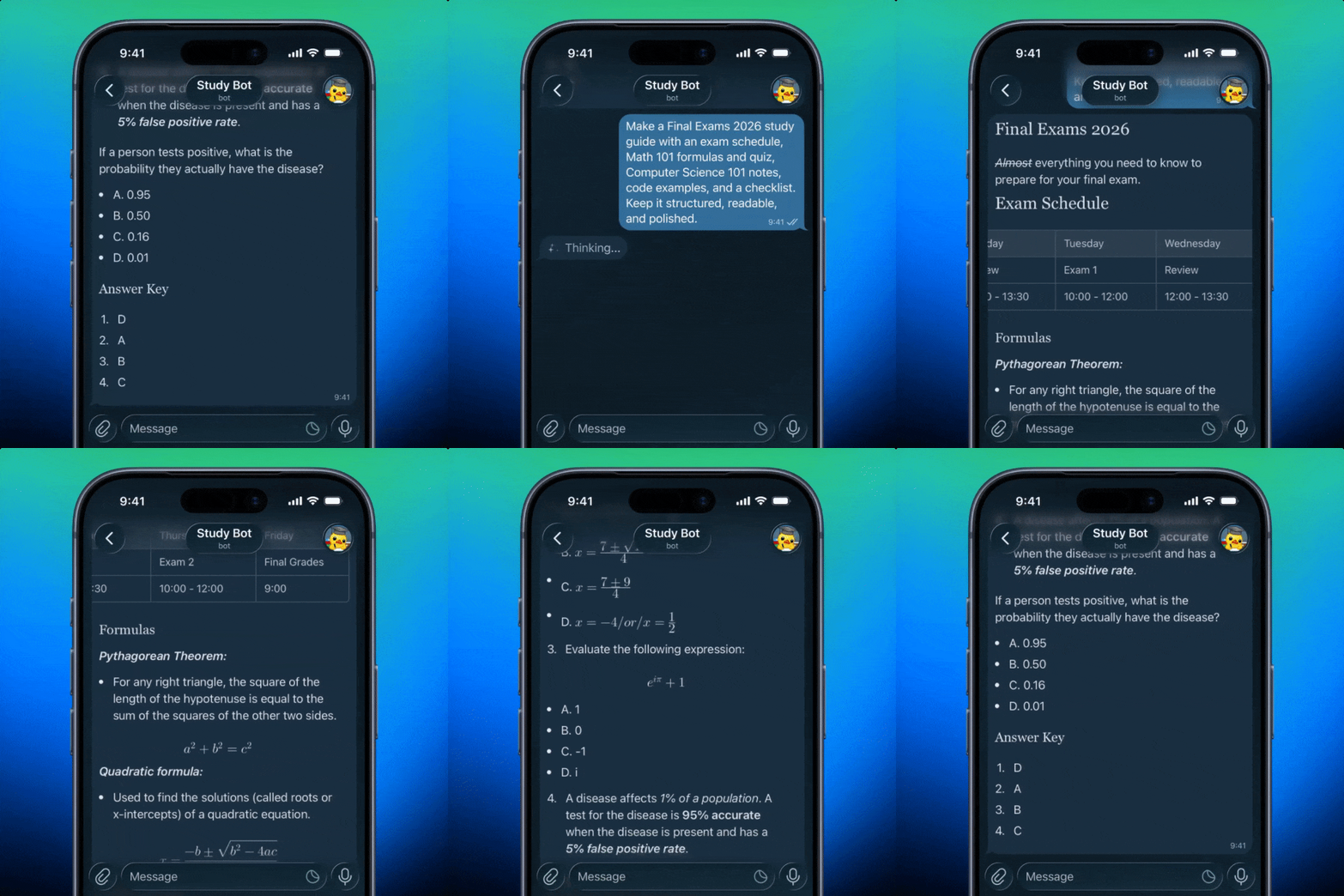
The deployment process has been streamlined into a specialized CLI tool called tgcloud. Developers can now treat their projects like standard Git repositories: local edits, atomic deployments, and data schema management via migrations. The integrated stack provides everything needed for a launch—from an embedded SQLite database to outbound HTTP traffic—eliminating the need for manual API key configuration or the installation of third-party packages.
Of particular note is the synergy between this serverless approach and the latest Bot API updates. The introduction of Rich Messages allows bots to render responses as complex tables, lists, and code blocks in real time. In the context of modern neural networks, this paves the way for truly seamless interfaces: an LLM can stream a response piece by piece, while the user sees professionally formatted content generated on the fly.
This evolution transforms Telegram into an ideal ecosystem for "digital assistants" and AI agents. By removing the requirement for dedicated servers, the barrier to entry for creating complex services drops nearly to zero, and scaling becomes automatic. Consequently, the platform is widening its technological lead over competitors by offering developers a comprehensive Fullstack experience within a single application.
Despite these obvious advantages, questions regarding monetization and infrastructure limits remain unanswered. Current documentation lacks details on pricing or resource quotas for V8 usage, leaving room for speculation about potential free tiers for smaller projects.
 Intel’s Strategic Play for Advanced Packaging Supremacy