The trend toward miniaturizing high-performance computing is reaching a new inflection point. While the consumer market remains tethered to standard PCIe slots, the professional sector demands unprecedented component density and architectural flexibility. MaxSun is challenging conventional design paradigms by integrating MCIO interfaces into the compact Mini-ITX form factor—a move that signals a strategic shift from traditional desktop configurations toward high-density, modular computing clusters.
The contemporary landscape of server and telecommunications infrastructure has long since transcended the constraints of standard connectors. In place of cumbersome slots, the industry is pivoting toward MCIO (Mini Cool Edge I/O)—a high-speed interface engineered to deliver maximum throughput within a minimal physical footprint. By enabling the transmission of PCIe Gen4, Gen5, and the prospective Gen6 signals via compact cable interconnects, MCIO fundamentally reimagines the spatial organization of the system chassis.
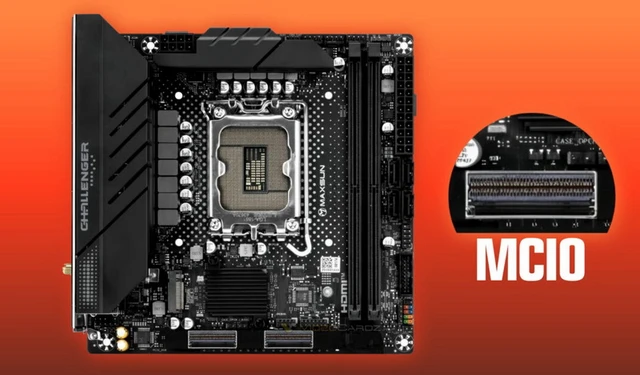
This philosophy underpins the latest offerings from MaxSun. The MS-Challenger MCIO ITX is a comprehensive architectural overhaul of the previously known MS-Challenger H810ITX WIFI. The most pivotal modification is structural: the conventional PCIe x16 slot has been entirely eliminated. In its stead, the PCB now features two MCIO connectors, transforming the motherboard from a foundation for a single graphics adapter into a versatile hub for interfacing with external accelerators or high-density storage arrays.
The model's technical versatility is striking. The board will be available in four configurations based on Intel Q870, Z890, H810, and B860 chipsets. For high-performance workloads, the Q870 and Z890 versions support PCIe lane bifurcation, allowing channels to be split into x8+x8 or x8+(x4+x4) modes. The more accessible H810 and B860 variants utilize an aggregated x16 mode distributed across the two MCIO interfaces.
A distinct engineering feat is the MS-PC Farm B860I, specifically tailored for the deployment of high-density compute clusters. Its standout feature is the inclusion of four DDR5 UDIMM slots—an anomaly for the Mini-ITX form factor. To accommodate this memory capacity while maintaining compatibility with narrow server chassis, engineers implemented an unconventional layout: the CPU socket and RAM slots are oriented at an angle, optimizing thermal dynamics and streamlining installation within rack-mount systems.
In contrast to the Challenger series, the MS-PC Farm B860I retains a single traditional PCIe expansion slot, supplementing it with two MCIO connectors. However, its primary value proposition lies in its management suite. Support for IPMI (Intelligent Platform Management Interface) empowers administrators to perform remote monitoring and system management without requiring physical access to the server. Additional capabilities, such as out-of-band BIOS flashing and intelligent diagnostics, elevate this board to an enterprise-grade instrument for data center environments.
Clearly, these solutions are not aimed at the consumer gaming market, where GPUs still necessitate a direct PCIe x16 connection. However, in the context of constructing server racks or systems with external GPU farms, MCIO provides unparalleled flexibility. By abandoning the rigid hardware coupling of components in favor of cable interconnects, developers can more efficiently distribute bandwidth and optimize cooling, transforming a compact Mini-ITX board into a potent node for distributed computing.
 The Economic Paradox of the GeForce RTX 5090