The global AI arms race is shifting its focus from algorithmic debates toward the raw physics of hardware scaling. Nvidia is finalizing the rollout of its next-generation server architectures—systems designed to serve as the bedrock for the next evolutionary leap in Large Language Models (LLMs). This isn't merely a quest for higher throughput; it represents a fundamental paradigm shift in how data centers are conceived and constructed. Computational efficiency is now inextricably linked to the infrastructure's capacity to manage staggering thermal demands and complex logistical overhead.
The high-performance computing (HPC) landscape has reached a critical inflection point where the primary bottleneck is no longer software optimization, but rather the physical logistics of hardware delivery and deployment. Nvidia, having effectively monopolized the AI accelerator segment, is now moving into the full-scale rollout of its Vera Rubin generation systems. This hardware is already being integrated into the infrastructures of the world's largest tech titans, signaling the conclusion of the most precarious phase: the transition from prototype to industrial scaling.
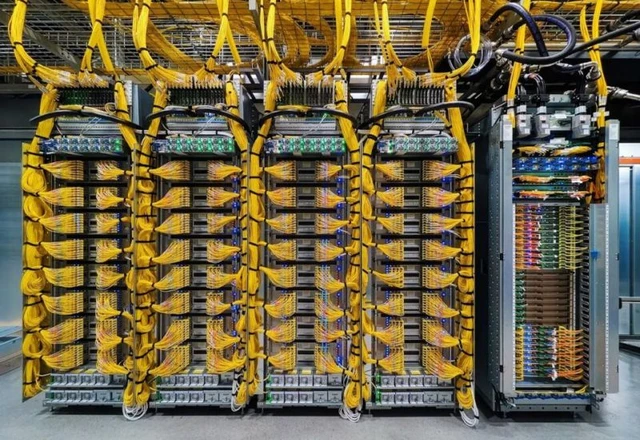
The primary challenge in deploying new generations of server systems has always been the friction associated with commissioning. However, with Vera Rubin, the focus has shifted toward a radical simplification of the physical layer. Nvidia’s engineers have overhauled server layout strategies to minimize cabling wherever possible. This shift is driven by the necessity of automation; the modern data center must be assembled by robots rather than humans to eliminate human error and accelerate the deployment of clusters comprising thousands of nodes.
Parallel to this is a fundamental transformation in thermal management. The transition to liquid cooling does more than just efficiently dissipate heat from ultra-powerful chips; it significantly optimizes internal chassis space by removing cumbersome fan arrays. This creates a powerful synergy: the hardware becomes denser, more energy-efficient, and easier to maintain.
Among the early adopters of this new infrastructure are giants such as Google, Microsoft, Meta Platforms, and Dell Technologies. OpenAI is particularly noteworthy, with plans to begin large-scale operation of Vera Rubin systems within the current quarter. To validate the hardware's capabilities, Nvidia has established specialized experimental hubs in California, allowing clients to conduct rigorous stress tests and evaluate real-world applicability to their specific workloads before committing to massive procurement cycles.
The technical benchmarks for Vera Rubin represent a staggering leap forward. According to data from CoreWeave, token generation throughput in these new systems has increased tenfold compared to previous generations. This is a critical metric for the commercial sector, as the cost per inference request is directly tied to data output speed.
The hardware rivalry is also intensifying. Nvidia claims significant superiority in Python programming tasks—the lingua franca of the AI industry. Internal benchmarks suggest that Vera's performance nearly doubles that of AMD’s Turin. AMD has countered these assertions, pointing toward the upcoming release of its Venice processors, which they believe will close this performance gap.
Ultimately, Vera Rubin is not merely an iterative upgrade; it is an attempt to build a cohesive ecosystem where hardware, cooling methodologies, and assembly processes function as a single, integrated mechanism. In an era where demand for compute power is growing exponentially, victory belongs to whoever can construct the most reliable and scalable "intelligence factory."
 Energy Autonomy: The Extreme Edition