The transition to fully autonomous transport demands a fundamental reimagining—not just of control algorithms, but of how vehicles interface with the external world. Tesla’s FSD strategy is rooted in emulating human vision, striving for maximum independence from static digital maps. However, the integration of satellite hardware into the new Cybercab robotaxi signals a pursuit of absolute fault tolerance. This evolution transforms the vehicle from a mere data consumer into a fully integrated node within a global communications network.
Tesla’s philosophy of autonomous driving is built on a fundamental rejection of traditional "crutches," such as high-precision digital maps. While most competitors rely on detailed HD mapping and expensive LiDAR arrays, the Full Self-Driving (FSD) system strives for biological mimicry. By processing visual streams from onboard cameras through deep neural networks, it effectively "sees" the road much like a human does. In this paradigm, constant internet connectivity for map correction is treated as a secondary concern.
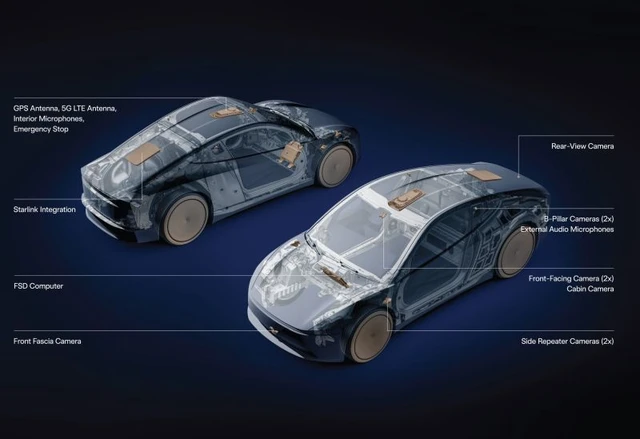
However, the technical architecture of the new Cybercab robotaxi reveals a more sophisticated layer of strategic planning. An analysis of the system layout shows a Starlink satellite antenna integrated directly into the trunk lid. This hardware sits alongside traditional 5G (LTE) modules, interior microphones, and an emergency stop system, establishing a multi-layered communication framework.
The Cybercab’s technical arsenal includes eight external cameras providing comprehensive 360-degree spatial awareness. Of particular interest are the microphones embedded in the body's pillars. Their utility extends beyond simple voice commands; they are likely designed for acoustic environmental analysis. This allows the system to identify emergency sirens or recognize passenger requests before they even enter the cabin—a critical capability for driverless transport.
The necessity of Starlink V5 in a vehicle that can theoretically operate autonomously remains an open question, but the answer lies in the principle of redundancy. In dense urban canyons or areas with unstable cellular coverage, the satellite link becomes the sole guarantee of connectivity. While current robotaxi deployment plans focus on regions with developed infrastructure, the inclusion of Starlink lays the groundwork for global expansion into any geographic territory.
Beyond technical reliability, there is a profound synergy at play between Tesla and SpaceX. Turning every Cybercab into an active satellite network subscriber creates a new stream of recurring revenue for Musk’s aerospace venture. Thus, the integration of Starlink is not merely an engineering safety net, but a strategic move toward a closed-loop ecosystem where transportation and connectivity merge into a single technological stack.
 Tesla Cybercab: The Autonomous Expansion