The semiconductor industry is currently swept up in an AI frenzy, rebranding every new piece of silicon as a cornerstone for the "AI PC." However, real-world market demands often necessitate a more pragmatic approach to hardware resource allocation. AMD is quietly diversifying its mobile processor portfolio, introducing solutions that decouple raw computational throughput from specialized neural processing capabilities. This strategic pivot allows for the optimization of cost and power efficiency without compromising core performance.
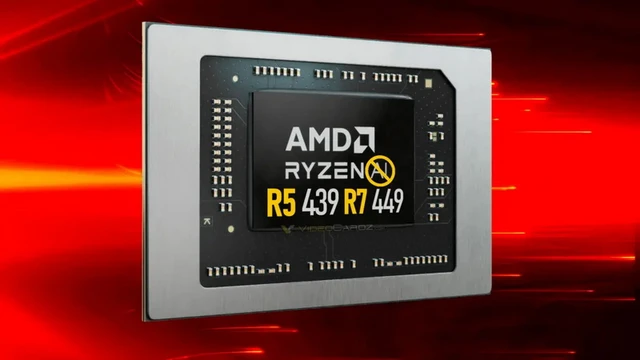
AMD's current strategy reveals an intriguing segmentation of its product lines. The company has introduced two new mobile processor models—the Ryzen 5 439 and the Ryzen 7 449—which, despite belonging to the Gorgon Point family, carry the concise branding of the "Ryzen 400 Series." The defining characteristic distinguishing these chips from the flagship Ryzen AI series is the complete absence of a Neural Processing Unit (NPU). In an era where the marketing narrative has shifted heavily toward TOPS (trillions of operations per second), the introduction of models without AI accelerators appears to be a strategic response to a market segment that prioritizes traditional raw performance over the ability to run large language models locally.
The Ryzen 5 439 utilizes a heterogeneous architecture, combining six cores: three high-performance Zen 5 cores and three efficiency-focused Zen 5c cores. This configuration allows for flexible workload management, delivering clock speeds of up to 4.6 GHz on the primary cores and up to 3.3 GHz on the compact cores. The L3 cache stands at 8 MB, which is sufficient for most everyday tasks and moderate multitasking. The graphics subsystem features the Radeon 840M integrated solution based on the modern RDNA 3.5 microarchitecture, utilizing four compute units clocked up to 2.8 GHz.
To contextualize the positioning of the Ryzen 5 439, it is useful to compare it with the Ryzen AI 5 Pro 440. Both chips share an identical core structure (3+3), yet the "Pro" version boasts a higher clock ceiling (up to 4.8 GHz) and double the L3 cache (16 MB). However, the fundamental divergence lies in AI capabilities: the Pro model is equipped with an NPU delivering 50 TOPS, which, combined with other blocks, results in a total of 59 TOPS. The Ryzen 5 439 lacks this functionality entirely, making it a more accessible and power-efficient option for standard laptops.
The more powerful entry in the lineup, the Ryzen 7 449, offers a full complement of eight cores and 16 threads, split evenly between Zen 5 and Zen 5c architectures (4+4). Clock speeds are notably higher here: the performance cores can reach 5.0 GHz, while the efficiency cores hit 3.4 GHz. The L3 cache is expanded to 16 MB, significantly enhancing the processor's capabilities in compute-intensive applications. Graphical potential is similarly bolstered via the Radeon 860M, which features eight RDNA 3.5 compute units running at up to 2.8 GHz.
The Ryzen AI 7 Pro 450 serves as the counterpart to this chip. The comparison reveals a similar pattern: the Pro version offers slightly higher frequencies (up to 5.1 GHz for Zen 5 and 3.6 GHz for Zen 5c) and accelerated graphics reaching 3.1 GHz. The primary advantage of the Pro model remains the NPU with 50 TOPS, providing total AI computing power at the level of 66 TOPS.
The technical implementation of this segmentation remains an open question. AMD has not specified whether the absence of the NPU in the Ryzen 439 and 449 models is the result of physical disabling during production (binning) or a software-level restriction. Regardless, the emergence of these processors confirms that the mobile systems market still demands classic computing solutions where efficiency is defined not by the number of neural operations, but by the balance of clock speeds, cache, and power consumption.
 The Price of Acceleration: CXMT’s Rapid Push into Memory