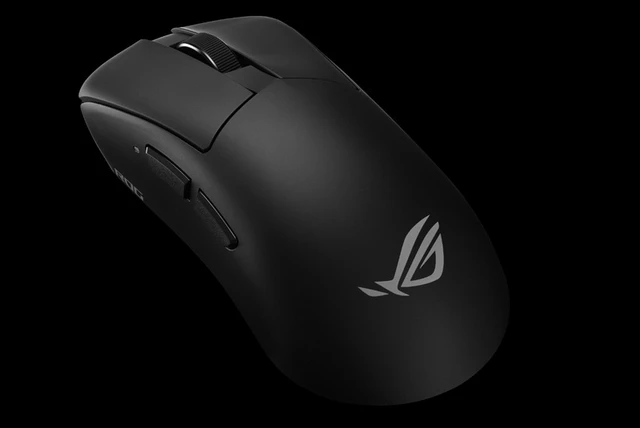
The contemporary esports peripherals market is driven by a relentless pursuit of extreme weight reduction and the absolute minimization of latency. In a landscape where milliseconds dictate the outcome of a match, hardware must evolve into a seamless extension of the player's own reflexes. The new ROG Gladius IV Ace from Asus seeks to merge uncompromising technical prowess with granular physical customization. This device represents an ambitious effort to engineer a universal tool capable of adapting to the most stringent demands of professional gaming.
The ROG Gladius IV Ace is engineered around a singular obsession: absolute tracking precision. The device features a cutting-edge optical sensor boasting a resolution of 65,000 DPI—a figure that may seem excessive at first glance, yet its true value lies in its dynamic performance. With a tracking speed of 650 IPS and 70G acceleration, the sensor maintains rock-solid stability even during the most abrupt, erratic movements. Particular attention has been paid to the lift-off distance (LOD), which offers 11 levels of adjustment. This is a critical parameter for low-sensitivity players who frequently lift and reposition their mouse across the pad; precise calibration here effectively eliminates unwanted cursor drift.
The device's technical architecture is geared toward the radical elimination of latency. Support for an 8,000 Hz polling rate—available in both wired USB-C and 2.4 GHz wireless modes—elevates system interaction to a new level of fluidity. While standard peripherals operate at 1,000 Hz, the leap to 8 kHz significantly narrows the data transmission interval, resulting in a seamless, instantaneous synergy between physical hand movement and on-screen action. For added versatility, a classic Bluetooth module is included, transforming this high-performance gaming tool into a sophisticated everyday office accessory.
The physical design of the ROG Gladius IV Ace aligns with the industry's current obsession: the race toward minimum weight. The base mass of the device is just 56 grams, reducing inertia and minimizing wrist fatigue during marathon sessions. However, Asus has introduced an intriguing experiment by adding a system of optional weights (3, 5, and 7 grams). This allows the user to strike their own balance between effortless agility and a sense of stability, effectively creating a hybrid between an ultra-lightweight peripheral and a classic ergonomic mouse.
Tactile reliability is anchored by the implementation of optical-mechanical switches. Unlike traditional mechanical switches, these systems are far less prone to wear and tear and entirely eliminate the dreaded "double-click" issue, boasting a lifespan of up to 100 million actuations. On the software front, Asus is pivoting toward minimalism with the Gear Link web application. This spares the user from installing bloated software on their system, allowing profiles and settings to be managed directly through a browser.
One of the more intriguing, albeit debatable, additions is Zone Mode—a suite of pre-configured profiles tailored for competitive disciplines. While intended to lower the barrier to entry for novices, for the seasoned esports athlete, such presets serve as a mere baseline; bespoke sensitivity tuning and custom macros will always take precedence over out-of-the-box algorithms.
Rounding out the package is a diverse aesthetic palette: the model will be available in black, white, red, and blue. The mouse ships with a dedicated carrying case, underscoring its status as a mobile tool designed for the rigors of tournament travel. The device is scheduled to hit the market in the third quarter of this year.
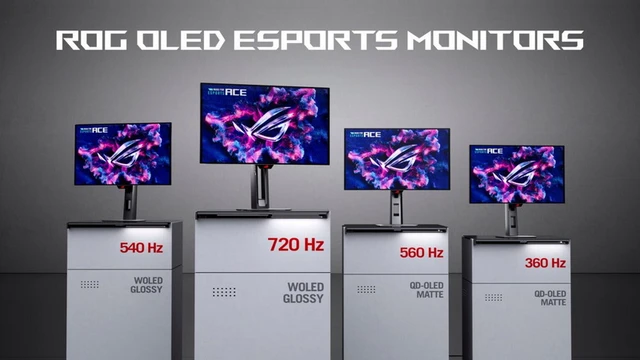 The Speed Limits of Modern Gaming Displays