The integration of cutting-edge robotics into assistive technology has reached a pivotal juncture, where raw functionality is beginning to supersede aesthetic appeal. While humanoid androids continue to grapple with fundamental motor coordination, quadrupedal systems are exhibiting remarkable stability and adaptability. A recent breakthrough from China is evolving the "robodog" concept from a mere technological novelty into a critical instrument for social integration. This shift heralds a new era—one where navigation algorithms step in to bridge the gap where biological capabilities fall short.
For years, the evolution of quadruped robotics was largely framed as a quest for the ideal platform for surveillance or search-and-rescue operations. However, the Zhiyuan Research Institute in Hangzhou has pivoted this trajectory with the introduction of Xiaoyuan, a specialized robotic guide. Unlike conventional models optimized for rugged terrain, Xiaoyuan is engineered to meet the stringent comfort and safety requirements of visually impaired users.
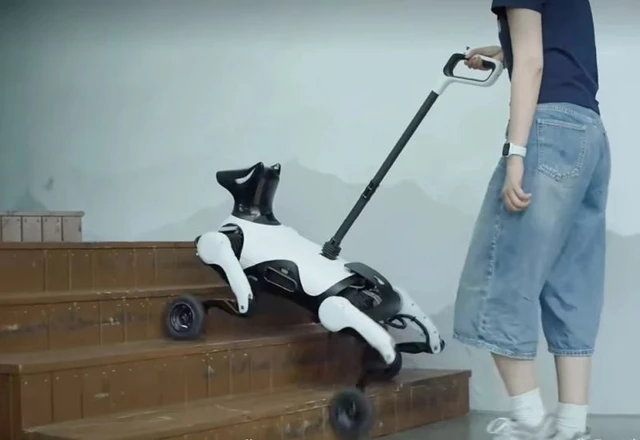
The centerpiece of the device is its hybrid locomotion system. By integrating wheels into each of its four limbs, the engineers have radically optimized energy efficiency and, more critically, ensured exceptional smoothness of motion. This configuration addresses two fundamental challenges: it minimizes the vibrations that could cause discomfort to the user and significantly lowers acoustic noise. For an individual relying on auditory perception to navigate their environment, the silent operation of actuators is a critical factor in preventing sensory overload.
Despite the wheels, the robot retains the inherent advantages of quadrupedal movement. Xiaoyuan can confidently navigate staircases and steep inclines while maintaining a stable trajectory. The sophistication of its navigation system allows for positioning accuracy within 30 centimeters—a level of precision comparable to that of a seasoned guide dog.
Particular emphasis has been placed on the machine's cognitive capabilities. While the traditional white cane is effective for detecting ground-level obstacles, it is powerless against hazards at chest or head height, such as low-hanging branches or signage. Xiaoyuan’s sensor suite closes this gap, providing comprehensive obstacle detection across the entire vertical profile of the environment. Object recognition efficiency reaches 99% indoors and approximately 96% in open spaces, rendering the device a reliable tool amidst urban chaos.
The system's intelligence layer extends beyond simple obstacle avoidance. The robot is integrated with digital terrain maps and possesses a database of urban accessibility, including the location of ramps and specialized lifts. Furthermore, a social interaction mechanism has been implemented: in the event of an unforeseen situation, the robot can autonomously request assistance from nearby volunteers registered in a dedicated database.
The socio-economic context of this development underscores its urgency. In China, where over 17 million people live with visual impairments, the existing infrastructure for training guide dogs is facing a systemic crisis. Training a single animal takes approximately a year and requires significant financial investment; meanwhile, the total number of trained dogs in the country is measured in the hundreds—a catastrophic shortfall given the scale of the need.
Transitioning to robotic systems allows for the scaling of assistance, eliminating biological risks and drastically reducing the time required to deploy a "companion." Ongoing trials involving volunteers across several regions of China aim to validate the hypothesis that a technological surrogate can serve as a fully functional and more accessible alternative to traditional guidance methods.
 The Triumph of 3nm Chip Manufacturing