The contemporary smartphone market has reached a distinct plateau in power efficiency, where the industry is fighting for every single percentage point of battery capacity without compromising device dimensions. Xiaomi is disrupting this stagnation with the introduction of the Redmi K100 series, delivering unprecedented benchmarks in both endurance and raw processing power. At the heart of these devices are innovative silicon-based power architectures and extreme display refresh rates—technologies designed to blur the line between a mobile phone and a comprehensive portable workstation.
The new Redmi K100 lineup represents a bold reimagining of hardware architecture, where performance is no longer constrained by the thermal envelope or battery capacity. At the heart of the base Pro model lies the Snapdragon 8 Elite Gen 5V Series processor, augmented by specialized optimization solutions: the Xiaomi D2 discrete graphics chip and the T1+ signal booster. This synergy allows the device to handle demanding visual workloads while maintaining uninterrupted connectivity even within dense urban environments.
To mitigate thermal throttling during peak loads, engineers have implemented an advanced cooling system. This includes not only a vapor chamber spanning 5,150 mm² but also an active circulation pump, effectively transforming the smartphone's internal chassis into a high-efficiency heat exchanger. Memory is handled by current industry standards—up to 16 GB of LPDDR5X RAM and up to 512 GB of UFS 4.1 storage—ensuring near-instantaneous responsiveness for HyperOS 3.0.
The visual experience centers on a 6.59-inch OLED display. Its standout feature is a 185 Hz refresh rate, which significantly exceeds current industry benchmarks to deliver exceptional fluidity in both UI navigation and gaming. A peak brightness of 2,200 nits guarantees legibility under direct sunlight, while DC Dimming technology minimizes flicker, reducing eye strain during low-light usage.
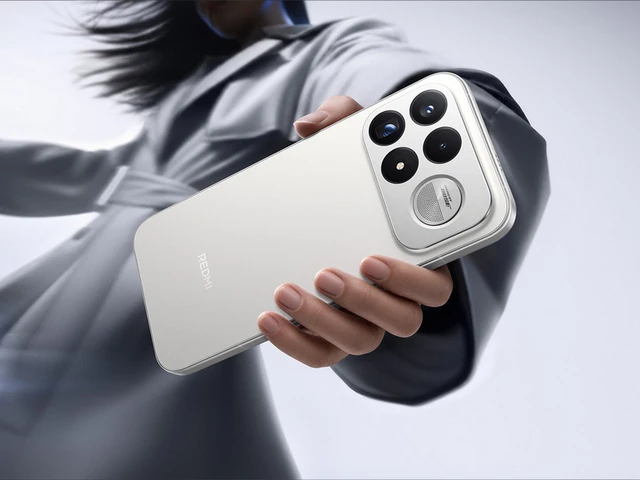
The Redmi K100 Pro's imaging array is led by a 200-megapixel primary sensor with Optical Image Stabilization (OIS), working in tandem with a 50-megapixel telephoto lens and an 8-megapixel ultrawide module. A 32 MP front-facing camera completes the suite, enabling high-resolution content creation across all scenarios.
The true paradigm shift occurs in power management. The integration of a Jinshajiang battery with a capacity of 8,580 mAh was made possible by a silicon-carbon anode containing 26% silicon. This achieves an energy density of 945 Wh/L, effectively packing more power into a smaller footprint. The energy ecosystem is supported by 100W wired fast charging and 50W wireless charging; additionally, the device can function as a power bank, delivering up to 27W via cable and 22.5W through its wireless interface.
The K100 Pro Max pushes these boundaries even further. It utilizes the Snapdragon 8 Elite Gen 5 paired with an even more robust thermal solution, with the vapor chamber expanded to 6,300 mm². The camera system receives a significant upgrade: both the ultrawide and periscope telephoto lenses now boast 50 MP resolutions, vastly expanding zoom capabilities and detail in landscape photography.
The Max version's battery reaches an impressive 9,070 mAh. Although the silicon content is reduced to 16%, the overall capacity allows the device to operate for several days under moderate usage patterns. Despite this, the physical footprint remains restrained, with a chassis thickness of just 8.45 mm and a weight of 238 g.
Both devices feature comprehensive environmental sealing with IP66, IP68, and IP69 ratings, making them resilient against dust, immersion in water, and high-pressure jets. Data security is handled by an ultrasonic fingerprint scanner, which offers faster and more reliable authentication than traditional optical sensors.
The series' strategic market positioning underscores a commitment to making flagship technology accessible. The Redmi K100 Pro starts at $550 for the 12/256 GB configuration, while the more powerful and autonomous K100 Pro Max begins at $670 for the same memory capacity.
 The Evolution of Apple's Augmented Reality Ecosystem