The contemporary space launch market is pivoting rapidly toward medium-lift reusable systems. Rocket Lab, having solidified its reputation with the Electron small-satellite launcher, is now scaling up to its most ambitious endeavor yet: the Neutron rocket. Central to this architecture is the Archimedes engine, engineered to provide the requisite thrust and reliability for heavy-payload orbital missions. Recent full-scale tests in Mississippi underscore the project's technical maturity as it advances toward its next developmental milestone.
While the Electron small-lift launch vehicle continues its methodical mission, Rocket Lab is shifting its focus toward the development of a more powerful and technologically advanced vehicle: Neutron. This project is designed to propel the company into the premier tier of commercial spaceflight, enabling the deployment of significantly heavier payloads. A pivotal milestone toward the maiden flight has been the successful full-scale hot fire test of the Archimedes second-stage engine.
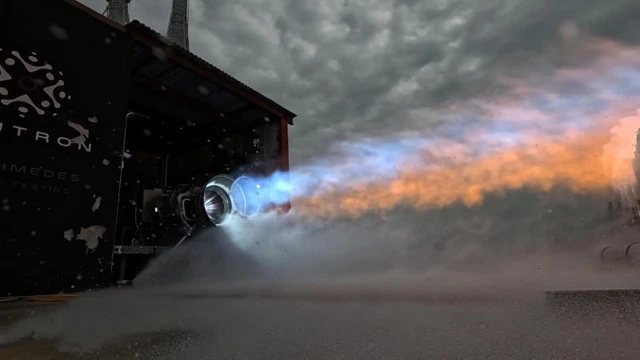
The tests were conducted at a dedicated facility within the Stennis Space Center in Mississippi. Engineers simulated operational flight profiles, firing the unit for over five and a half minutes. This exercise validated the system's stability and its ability to withstand the rigorous demands imposed on modern orbital launch vehicles.
The Neutron concept is built upon a philosophy of reusability—a paradigm that has become the industry standard following the successes of SpaceX. The first stage is powered by eight Archimedes engines, delivering a combined thrust of nearly 680 ton-force. In terms of performance, each individual engine is comparable to the Merlin 1D utilized on the Falcon 9. This configuration allows the first stage to return to the launch site or land on an autonomous drone ship, radically reducing the cost per launch.
However, the true engineering audacity is evident in the second stage and the payload protection system. In conventional rockets, fairings are jettisoned immediately upon entering vacuum to shed weight. Neutron employs a fundamentally different approach: the fairing opens like a clamshell. This system—internally dubbed the "Hungry Hippo"—allows the second stage to remain within the protective envelope until the final moments before reaching the target orbit.
For operation in vacuum conditions, a specialized engine modification was developed: the AVac. Vacuum optimization required a significant increase in nozzle size, making it approximately 2.5 meters longer than the first-stage variant. This adjustment increased thrust by 1.2x through more efficient expansion of working gases. During ground testing, engineers utilized temporary "short skirts"—specialized adapters that compensated for the nozzle's excessive height, allowing the engine to be safely tested on the stand without compromising the ability to evaluate its future orbital efficiency.
The path to realizing Neutron has been fraught with challenges, marked by the kind of schedule adjustments typical of the aerospace industry. Initial plans for a late 2025 launch have shifted to the first half of 2026. Further delays followed an incident in January, when a primary stage fuel tank ruptured during pressure testing. Nevertheless, the successful Archimedes engine tests demonstrate that the propulsion system is flight-ready; the primary hurdles now lie within materials science and structural airframe integrity.
 A Pragmatic Approach to Lunar Equipment Design