The handheld gaming market is undergoing a period of rapid evolution, evolving from a niche curiosity into a viable alternative to traditional desktop PCs. In the pursuit of the perfect equilibrium between portability and raw power, specialized silicon and sophisticated thermal management systems have become the primary battlegrounds. Acer is making a bold move with the introduction of the Predator Atlas 7, a device engineered to redefine the ergonomics of mobile gaming. At its core, the device leverages the prowess of Intel Arc graphics, promising an uncompromising visual experience delivered within a compact form factor.
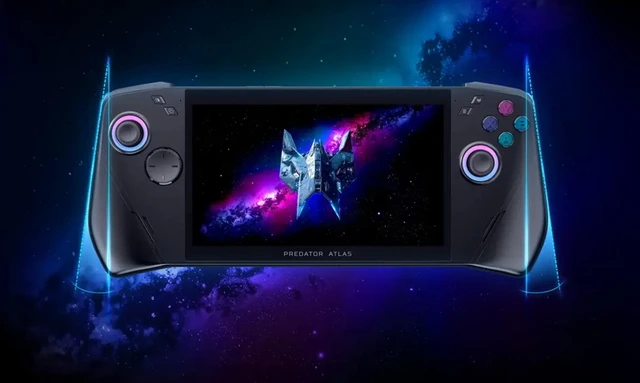
The evolution of the Predator Atlas series culminates in the Atlas 7, a more compact and refined iteration of its predecessor. The primary shift is the transition to a 7-inch display format, allowing Acer to optimize the device's footprint without compromising raw computing power. The visual experience is delivered via an IPS panel with a 1920 × 1080 resolution, where a 120Hz refresh rate and VRR support ensure fluid motion even during the most demanding sequences. With a peak brightness of 500 nits and 100% sRGB coverage, the screen is well-suited not only for gaming but also for content creation, while the Acer DXC anti-glare coating and Gorilla Glass Victus provide the necessary durability and visual comfort under any lighting conditions.
At the core of the system are the specialized Intel Arc G-Series processors, engineered specifically to operate within the stringent power envelopes of handheld devices. Users can choose between two configurations: the Arc G3 and the higher-performance Arc G3 Extreme. The latter features the Arc B390 GPU with 12 Xe3 cores, while the standard version relies on the B370 with 10 cores. Of particular importance is the integration of XeSS 3 technology, including Super Resolution and multi-frame generation, which significantly boosts frame rates in demanding titles through intelligent upscaling.
To ensure the graphics stack operates without bottlenecks, Acer has equipped the device with a substantial memory overhead—up to 24GB of LPDDR5X RAM clocked at 7467 MHz. High memory bandwidth is paramount for integrated solutions where VRAM is shared with the system. Data storage is handled by a high-speed PCIe 4.0 M.2 2280 SSD with a 1TB capacity, ensuring near-instant level loads and rapid access to game libraries.
Thermal throttling is a perennial challenge for compact gaming systems, and Acer has addressed this with engineering precision. Cooling is managed via a dual-fan array, centered around the Predator AeroBlade metal fan. Its ultra-thin blades, measuring just 0.1mm, allow for massive airflow with minimal acoustic noise. This is complemented by the Vortex Flow ducting system, which optimizes internal airflow to eliminate "hot zones" within the chassis.
Battery life depends on the chosen configuration, with options for 60Wh and 80Wh cells. This choice directly impacts the device's weight: the model with the smaller battery weighs under 700 grams, while the maximum-autonomy version reaches 750 grams. For comparison, the previous 8-inch Atlas 8 was noticeably heavier, surpassing the 810-gram mark.
Control ergonomics have been elevated through the introduction of TMR (Tunnel Magnetoresistance) joysticks in select modifications, virtually eliminating the issue of stick drift. Hall Effect analog triggers provide precision input, while additional rear macro buttons expand control possibilities in complex genres. Security and accessibility are handled via a fingerprint scanner integrated directly into the power button.
The hardware stack is rounded out by two Thunderbolt 4 ports, enabling ultra-fast data transfer and external monitor support, alongside the latest Wi-Fi 7 and Bluetooth 5.4 standards. A UHS-II microSD card reader allows for easy storage expansion without requiring the chassis to be opened.
The global rollout of the Predator Atlas 7 is expected in late 2026, with the device arriving in North America in the fourth quarter and in the EMEA region by November. While official pricing remains undisclosed, the device is positioned as a high-performance instrument for those who value mobility but refuse to compromise on power.
 The Foldable iPhone: A New Chapter for Apple