The boundary between fan-driven creativity and commercial intellectual property infringement is frequently a gray area. The recent dispute involving Dbrand—whose designs drew inspiration from the iconic imagery of Portal—serves as yet another flashpoint where Valve’s corporate mandates collide with the audacious strategies of third-party accessory manufacturers. This incident underscores the stringent licensing frameworks that govern the modern gaming hardware industry, revealing that the conflict is not merely about a device's aesthetics, but rather an uncompromising stance on brand protection.
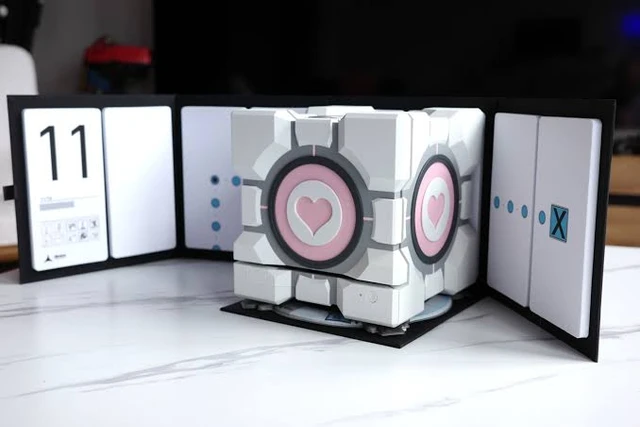
The clash between Dbrand and Valve ignited with an ambitious venture: a Steam Machine chassis styled after the iconic Companion Cube from the Portal series. The product was an instant sensation, becoming one of the fastest-selling accessories in Dbrand's history, eclipsed only by the Killswitch line for the Switch 2. Yet, this commercial triumph proved fleeting; within hours of launch, Valve demanded an immediate cease-and-desist and the removal of all promotional materials.
At the heart of the dispute was the absence of formal licensing for the intellectual property. Adhering to its habitual "act now, ask later" ethos, Dbrand released the product without prior authorization from the rights holder. Subsequent attempts to negotiate a retroactive blessing on Dbrand's terms were met with a categorical and final refusal from Valve.
Behind this brief episode lay a staggering amount of effort. Development began as early as November 2025, immediately following the Steam Machine's unveiling. The project consumed over a thousand man-hours, with the concept being overhauled several times to ensure absolute fidelity to the game's visual identity. Despite the $99 price point, the company effectively operated at a loss once R&D costs and customer refunds were factored in.
Parallel to this legal skirmish, Valve focused on the commercial rollout of the Steam Machine itself. Pre-order data reveals a clear segmentation strategy: ranging from a base 512GB model at $1,049 to a premium 2TB version priced at $1,428 when bundled with a controller. Aesthetics play a pivotal role here; beyond the standard black panel, options in red fabric and walnut are available, repositioning the device from a mere technical gadget to a piece of interior design.
However, the technical presentation required some fine-tuning. Valve was forced to walk back its performance claims: initial promises of a stable 60 FPS at 4K were tempered to "up to 4K" utilizing FSR 4.1 technology. Such pivots are commonplace in the industry, where the theoretical potential of upscaling—in this case, AMD FidelityFX Super Resolution—often clashes with the realities of game optimization and the thermal envelopes of compact systems.
 The Price of Acceleration: CXMT’s Rapid Push into Memory