For years, computer vision has been tethered to either cumbersome stereo camera arrays or power-hungry active sensors, such as LiDAR, to perceive spatial depth. Modern robotics, however, is pivoting toward "biological efficiency"—a paradigm where minimal hardware overhead yields maximal environmental awareness. A new breakthrough from Spanish engineers is redefining this trajectory, introducing a system capable of perceiving three-dimensional volume through a single lens. This leap forward is driven by a sophisticated synthesis of neuromorphic technology and innovative optics.
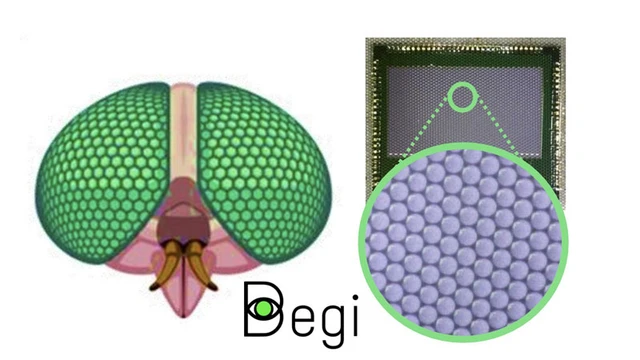
Historically, spatial awareness in robotics has relied upon either redundant camera arrays to create a stereo effect or the emission of active light pulses. However, the IKERLAN technological center has introduced the BEGI prototype, a system that promises to shift this paradigm. By implementing the concept of "physical artificial intelligence," the device enables autonomous machines to perceive depth and environmental dynamics passively, mimicking the complex ocular structure of an insect.
At the heart of the system lies the Sony-Prophesee IMX636 dynamic image sensor. Unlike conventional sensors that capture frames at a fixed frequency, this neuromorphic sensor operates on an event-based principle: it transmits data only when it detects a change in brightness at a specific pixel. This approach drastically minimizes data redundancy and slashes reaction latency to the microsecond level.
The pivotal engineering breakthrough is the integration of a microlens array atop the sensor. This architecture allows the system to determine the direction of incoming light for every individual pixel. When paired with a direct stereo reconstruction algorithm, it enables the calculation of object geometry, distance, and optical flow using only a single lens.
The prototype's technical specifications are impressive in their efficiency: the matrix resolution stands at 1280 × 720 pixels, with latency not exceeding 100 $\mu$s under 1,000 lux of illumination. Furthermore, the device boasts a dynamic range exceeding 120 dB and consumes approximately 205 mW, making it an ideal candidate for systems with stringent power and thermal management constraints.
Nevertheless, the current iteration of BEGI faces a fundamental bottleneck regarding resolution. For accurate depth perception, a single point in space must be registered by multiple pixels from different angles; at this stage, this limitation restricts the system's effective operating range to less than one meter, with a field of view (FOV) between 20 and 40 degrees.
These parameters currently confine the prototype to short-range applications. Potential use cases include high-precision manipulators on industrial assembly lines, monitoring moving mechanical components, or the final stages of spacecraft docking—scenarios where an instantaneous response to minimal object displacement is critical.
Currently, the system's computational logic is implemented via Field Programmable Gate Arrays (FPGAs), which process event streams to generate depth and dynamics maps. The roadmap for further development involves transitioning to Application-Specific Integrated Circuits (ASICs) and implementing large-format sensors with higher pixel density.
According to the developers, scaling the matrix will extend the perception distance up to 16 meters and expand the field of view to 120 degrees. This evolution would transform BEGI from a niche sensor into a universal navigation tool for mobile robots and autonomous vehicles, all while maintaining its primary advantage: the exceptional lightness and energy efficiency of a single-lens design.
 The Price of Acceleration: CXMT’s Rapid Push into Memory