The era of GPU dominance in artificial intelligence is entering a transformative new phase. Driven by the rise of autonomous AI agents and the increasing complexity of large-scale data processing, industry demand is pivoting toward high-performance central processing units (CPUs). Recognizing this shift, Nvidia is mounting a strategic offensive against the established incumbents of the market. The company aims to architect a seamless, holistic ecosystem where the CPU becomes an indispensable component of the overall computational pipeline.
For years, the industry perceived Nvidia primarily as the architect of the powerhouse GPUs that underpinned the generative AI boom. However, current technological trajectories suggest that raw graphical acceleration is no longer sufficient. The emergence of sophisticated AI agents and the necessity of processing colossal backend datasets have created a pressing demand for high-efficiency central processing units. In response, Nvidia has pivoted toward the mass deployment of Grace Arm-based servers, already shipping hundreds of thousands of units and forging strategic partnerships with titans such as Meta.
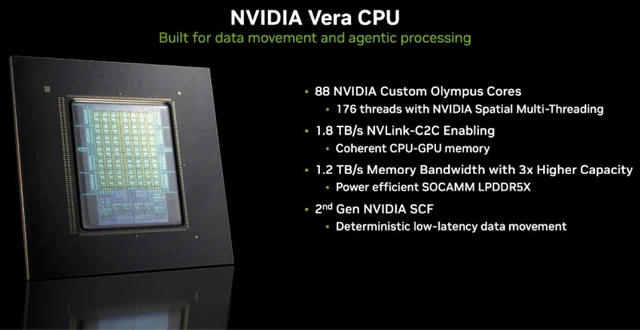
Nvidia’s architectural philosophy for CPU development diverges sharply from the strategies employed by Intel and AMD. While the traditional market leaders have long embraced chiplet designs—combining several smaller dies to increase core density—Nvidia has bet on a monolithic architecture for its Vera processor. This choice involves calculated trade-offs: specifically, eschewing an extreme core count (foregoing 128 cores) in favor of expanding the internal data bus.
This engineering pivot enables staggering on-chip bandwidth, reaching up to 3.4 TB/s. Consequently, every core can interact with any cache or memory controller at maximum velocity without collisions. Coupled with an LPDDR5X interface that delivers a total memory bandwidth of 1.2 TB/s (or 14 GB/s per core), Vera evolves into a tool optimized for workloads where data movement speed is more critical than raw thread count.
Admittedly, such a design may be overkill for many "traditional" data center workloads, for which hyperscalers have already developed their own optimized solutions. Nevertheless, within the context of next-generation AI infrastructure, Vera becomes a pivotal piece of a much larger puzzle.
Vera processors are woven into a broader ecosystem alongside Rubin-series GPUs, ConnectX-9 network adapters, and SpectrumX Ethernet switches. The pinnacle of this integration is the Vera Rubin NVL72 rack—a feat of extreme engineering comprising approximately 1.3 million individual components. The scale of producing such systems requires unprecedented coordination, involving a global supply chain of over 300 partners.
Nvidia maintains a bullish outlook on the CPU market's trajectory. The company forecasts that this segment could reach $200 billion by 2030, significantly outpacing the conservative estimates of other analysts. This position is bolstered by data from Morgan Stanley, suggesting that the evolution of AI agents could inject an additional $60 billion into the data center CPU market. Rather than pursuing a total monopoly with a single model, Nvidia is constructing a flexible hierarchy of computing power tailored to diverse operational demands.
 Energy Autonomy: The Extreme Edition