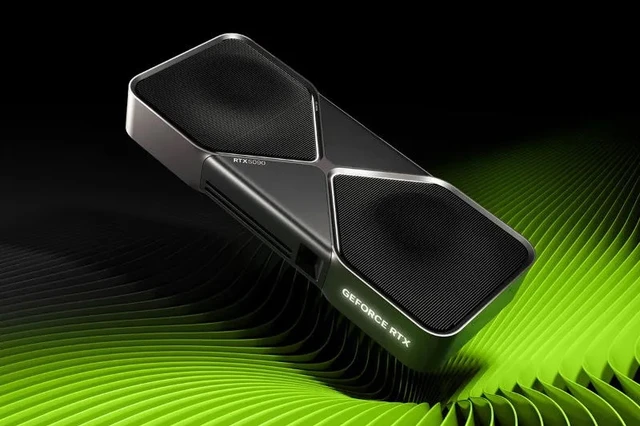
The rivalry between Nvidia and AMD in the GPU market has long since evolved beyond raw performance, shifting the battlefield toward software ecosystems and AI-driven algorithms. Neural rendering has emerged as the primary differentiator, drawing a sharp line between proprietary technologies and open standards. Yet, enthusiasts consistently demonstrate that technical barriers are surmountable, provided common ground can be found at the hardware level. The attempt to port DLSS 5 to Radeon RX 9000 GPUs serves as a case study in this process, exposing the stark divide between theoretical compatibility and real-world efficiency.
Modern gaming is driven by a relentless pursuit of photorealism, provided it doesn't come at the cost of a catastrophic collapse in frame rates. Nvidia's DLSS 5, engineered for the Blackwell generation (RTX 50), represents the zenith of neural rendering, where artificial intelligence assumes a significant portion of the image generation workload. While such tools were long considered inextricably linked to Nvidia's Tensor cores, the emergence of DLSS-NR has enabled this algorithm to run on AMD's Radeon RX 9000 series.
The technical feasibility of this port was predestined by a shared computational standard. DLSS 5 relies heavily on the FP8 (8-bit floating point) format, which significantly accelerates neural network processing while lowering memory and bandwidth overhead. Because the new RDNA 4 architecture in the Radeon RX 9000 series now features native FP8 support—mirroring the capabilities of the GeForce RTX 40 and 50 series—a software bridge between the two ecosystems became viable.
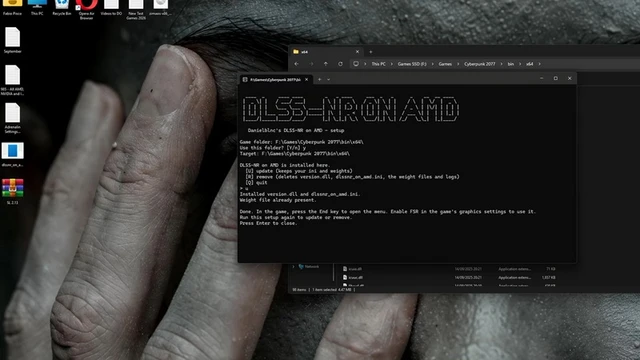
The implementation is a classic engineering hack. Integration is achieved by injecting a third-party DLL into the game's root directory, after which the neural rendering system is triggered via FSR 3 or FSR 4 profiles. However, this flexibility has its limits: the solution is strictly confined to single-player titles. In multiplayer environments, anti-cheat systems immediately flag and block third-party libraries, rendering DLSS-NR non-viable for competitive gaming.
Despite the technical triumph, the practical results remain underwhelming. The primary stumbling block is a catastrophic collapse in performance. In Cyberpunk 2077 benchmarks on a Radeon RX 9070 XT, early versions of the mod plummeted frame rates from a comfortable 80 FPS to a critical 11–12 FPS at 1080p. Even with the latest updates (Alpha v0.2.7), performance barely reached 30 FPS. For modern hardware that handles native rendering with ease, such figures render neural upscaling entirely redundant.
Support for DLSS 5 is inconsistent even within the Nvidia ecosystem. While officially tethered to the Blackwell architecture, Nvidia plans to optimize the technology for the RTX 40 series. Simultaneously, the modding community has attempted to port these algorithms to older generations, such as the RTX 30 and even RTX 20 series, where the performance degradation was equally dramatic.
At present, DLSS support on AMD cards remains more of a technical curiosity than a viable tool. It serves as a vivid demonstration that while a compatible computational format (FP8) is a necessary condition for neural networks, it is far from sufficient. Between the mere "ability to execute code" and a "fluid gaming experience" lies a vast chasm of driver optimization and low-level hardware interaction—a domain currently reserved exclusively for official developers.
 Energy Autonomy: The Extreme Edition