The current AI revolution is fueled not merely by raw computational power, but by massive financial leverage. Nvidia is playing a high-stakes game, tethering its future to aggressive guarantees issued to suppliers and partners. The scale of these commitments echoes the unsettling patterns of the dot-com era, where unchecked optimism paved the way for systemic collapse. The pivotal question remains: is the current demand rooted in fundamental value, or are we witnessing the inflation of yet another tech bubble?
The modern AI accelerator market resembles a gold rush, with Nvidia serving as the primary purveyor of the tools. However, beneath the meteoric rise in market capitalization lies a troubling trend in financial liabilities. According to recent financial reports, the company has more than doubled its obligations to suppliers, increasing them from $119 billion to $279 billion. These funds are earmarked for securing supply chains for critical memory and turnkey server systems, effectively positioning Nvidia as the primary guarantor of stability for the entire industry.
This strategy has sparked legitimate concern among analysts, who are drawing parallels to the dot-com crash of the early 21st century. At that time, Cisco Systems occupied a similar "picks and shovels" niche during the internet boom, providing massive financial guarantees to component manufacturers. When market exuberance gave way to a severe crisis, Cisco faced catastrophic losses, writing off $2.2 billion in a single quarter. History demonstrates that when infrastructure demand collapses, financial guarantees transform from engines of growth into shackles.
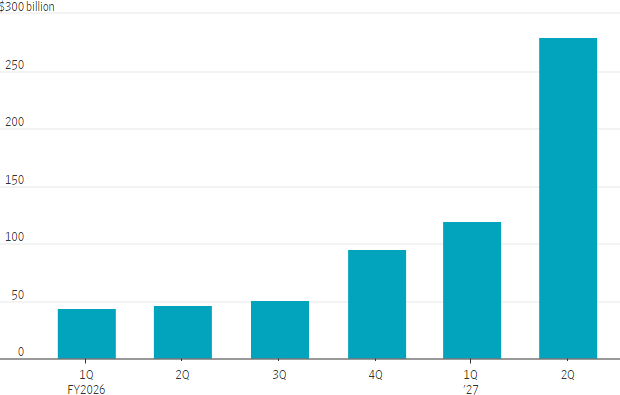
While today's AI landscape differs significantly from the scenario of the 2000s, the pace at which Nvidia's liabilities are growing is staggering. To soothe market nerves, company leadership has made an uncharacteristically audacious projection: revenue for the next fiscal year is expected to grow by 70%. Furthermore, the company asserts that the only limiting factor is supplier throughput—claiming that if components could be shipped faster, revenue growth would be even more aggressive. It is worth noting that the sharp spike in liabilities to $279 billion is partially driven by memory price volatility, rather than purely by the physical volume of orders.
However, Nvidia's financial expansion extends far beyond simple procurement. The company is essentially constructing its own ecosystem of lending and support. As part of an "AI Bank" initiative with a total capacity of $500 billion, Nvidia has already committed $125 billion, guaranteeing customers a minimum residual value for the accelerators they purchase. In essence, this serves as insurance against hardware obsolescence.
The scale of support for individual players is striking: guarantees for a single OpenAI data center reach $105 billion. Add to this $36 billion in obligations to cloud giants and $20 billion spent on data center leases for partners, and you have a complex web of interdependencies. Nvidia also acts as a guarantor for numerous AI startups, creating a closed-loop ecosystem: the company finances its customers so they can purchase its own products.
In an environment of continuous growth, such a strategy appears masterstroke, as it maximizes expansion and market capture. But this model functions only on the assumption that the demand for compute will grow indefinitely. Any deceleration in AI adoption or investor disillusionment regarding the ROI of neural networks could turn these intricate financial ties into a systemic risk capable of destabilizing even a giant of this magnitude.
 Nvidia’s Technological Pragmatism in the Open-Model Race