For years, the hierarchy of computing interfaces was dictated solely by the x86 titans, Intel and AMD. However, the meteoric rise of artificial intelligence and the migration of computational workloads toward GPUs have radically shifted the balance of power. Today, memory controller architects are increasingly aligning their strategies with Nvidia's roadmaps, effectively acknowledging the company as the new technological hegemon. This pivot signals a departure from a CPU-centric development model toward an ecosystem where data throughput is governed by the insatiable demands of graphics accelerators.
Historically, the adoption of new PCI Express standards across consumer and server segments has followed a trajectory dictated by Intel and AMD. It was the interface support within central processing units that determined when the market would receive new generations of SSDs and which speeds would become the benchmark for the average user. In recent years, however, Nvidia's influence has expanded to such a degree that it is no longer merely a graphics card vendor, but has evolved into the architect of the entire computing environment.
Silicon Motion, a leading controller developer, openly acknowledges this tectonic shift. In its roadmap for PCIe 6.0 implementation, the company is betting not on the traditional CPU market leaders, but on Nvidia's strategy. According to internal forecasts, a consumer-grade platform supporting PCIe Gen6 SSDs is expected to emerge by the end of next year. Crucially, the primary catalyst for this development has been the requirements of Nvidia, whose future consumer solutions will demand unprecedented bandwidth to move colossal volumes of data.
This trend was vividly apparent at Computex 2026, where Nvidia demonstrated its ambitions to extend its influence beyond the server rack. Modern neural network computations and complex graphical tasks are creating a severe I/O bottleneck. In this climate, high-speed PCIe 6.0 drives are no longer just an enthusiast novelty; they are a critical component without which the potential of Nvidia's next-generation processors will remain untapped.
Currently, the market is in a lull before the storm. PCIe 5.0 x4 solutions have been available for over three years, and while demand for the next generation is growing, actual products remain scarce. The sole representative of the PCIe 6.0 x4 class is the Micron 9650, which, however, is designed exclusively for the enterprise sector and cannot be integrated into a standard home PC.
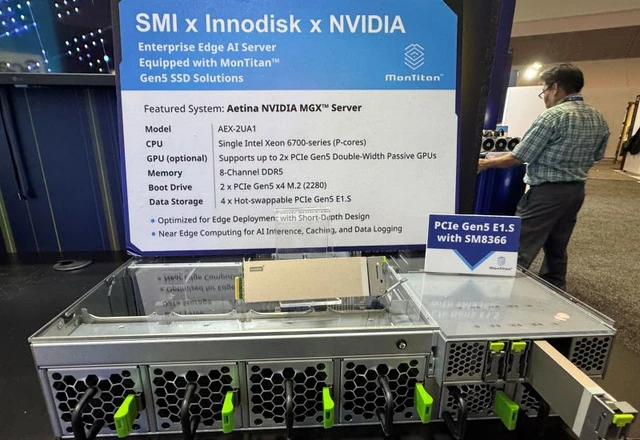
The enterprise segment is evolving more rapidly. This year, Silicon Motion plans to introduce the SM8466, a 16-channel controller with PCIe 6.0 support. This will enable new server processors, such as the AMD EPYC "Venice" generation and Nvidia "Vera Rubin," to operate in tandem with next-generation storage. Simultaneously, companies like Astera Labs are preparing the corresponding switches, establishing the necessary infrastructure foundation for the standard to function.
In the consumer sector, Intel and AMD are exercising caution. The primary obstacle here is the high cost of supporting infrastructure: maintaining signal integrity at such frequencies requires expensive PCB materials and sophisticated cooling systems. However, Nvidia, wielding immense leverage through its RTX Spark lineup, possesses the ability to engineer market demand, effectively forcing the rest of the industry to accelerate its adaptation.
Consequently, we are witnessing a rare phenomenon in IT history: peripheral devices and interfaces are beginning to evolve not in lockstep with the CPU, but in response to the demands of the GPU. By aligning itself with Nvidia, Silicon Motion is betting on a future where the GPU becomes the true gravitational center of the system, and the SSD serves as its high-speed fuel reservoir.
 The Speed Limits of Modern Gaming Displays