For years, the quest to build a truly versatile robotic assistant has been hindered by a persistent disconnect: the chasm between an AI's cognitive prowess and the physical dexterity of its mechanical hardware. While contemporary systems often exhibit a sophisticated grasp of high-level instructions, they frequently falter when tasked with executing the intricate spatial coordination required for real-world movement. A recent breakthrough from Google DeepMind aims to bridge this gap by shifting the paradigm of control—moving away from the management of isolated manipulators toward a model of integrated, holistic body orchestration. The objective is the achievement of true proprioception, allowing artificial intelligence to emulate the fluid and intuitive motor skills inherent to human movement.
The transition from managing discrete nodes to the systemic control of the entire organism represents a paradigm shift in robotics. Previous iterations of Gemini Robotics focused primarily on upper-body kinematics, which limited machines to stationary or restricted mobility systems. The second version radically pivots this approach: the neural network now coordinates every movement, from precise foot placement to the micromotorics of the fingertips.
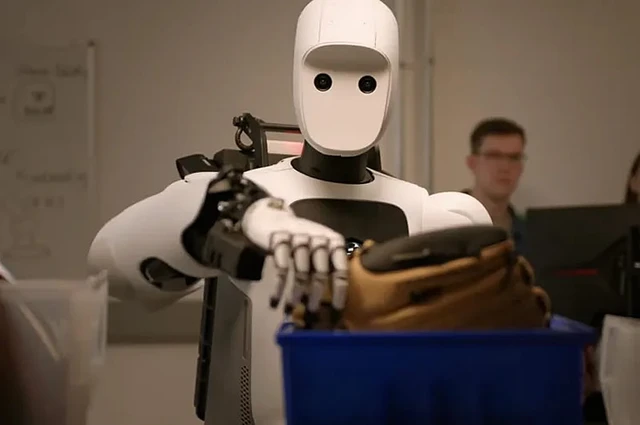
This approach is vividly demonstrated in Apptronik’s Apollo 2 humanoid. No longer merely a "manipulator on wheels," the robot has gained the capacity for complex dynamic maneuvers; it can walk, squat, and lean with confidence, maintaining balance while interacting with objects. The ability to retrieve a watering can from the floor or carefully extract an item from a shelf requires more than just precision—it demands a profound understanding of proprioception and spatial physics. While execution speed remains an area for optimization, the synchronization of the entire chassis paves the way for operation within unstructured, real-world environments.
Parallel to the evolution of motor intelligence is the advancement of the cognitive layer—the Gemini Robotics ER 2 model. This component handles environmental analysis and the interpretation of multi-stage instructions. A pivotal enhancement is the expanded context window; the robot can now retain task details over longer durations, clearly defining the start and end points of a process. This transforms command execution from a fragmented sequence of actions into a single, cohesive workflow.
Particularly compelling is the concept of multi-agent interaction. The new architecture enables the integration of diverse robot types into a single operational group, where one unit can act as a coordinator for another. In a garage cleaning scenario, the Apollo 2 humanoid effectively orchestrates the actions of a specialized dual-arm Google robot, delegating tasks and monitoring overall progress. This level of synergy brings us closer to fully autonomous ecosystems where disparate machine forms complement one another.
Human-machine safety has been elevated through the implementation of advanced presence detection mechanisms. The system is now more attuned to human proximity, triggering immediate safety-stop protocols—a critical requirement for deployment in residential or corporate settings.
The final touch is the optimization of the On-Device Model. By shifting a portion of the computation directly to the robot's onboard hardware, latency associated with cloud data transmission is minimized, ensuring operational autonomy even without network connectivity. This evolves the machine from a remote server terminal into a truly independent, intelligent entity.
 Anthropic’s Strategic Financial Surge Ahead of Its IPO