The personal computing landscape is undergoing a fundamental paradigm shift toward local AI execution. For years, the primary bottleneck hindering this transition has been a chronic shortage of VRAM, which constrained both the scale and the precision of deployable models. The new HP ZBook Ultra G3a 16 workstation is engineered to dismantle this barrier, delivering unprecedented capacities of unified memory. This machine evolves the laptop from a mere data-processing tool into a fully autonomous environment capable of deploying resource-intensive neural networks.
The contemporary landscape of mobile workstations faces a critical challenge: how to enable the execution of Large Language Models (LLMs) without relying on cloud computing. The answer lies in a deep technological synergy between HP and AMD, culminating in the ZBook Ultra G3a 16. At the heart of its flagship configuration is the Ryzen AI Max+ Pro 495—a 16-core, 32-thread powerhouse with clock speeds reaching 5.2 GHz. However, the true value of this silicon lies not in raw compute, but in the integration of the Radeon 8065S graphics core, featuring 40 compute units, and a specialized Neural Processing Unit (NPU) delivering 55 TOPS.
The pivotal technological breakthrough is the implementation of unified memory. The top-tier version is equipped with 192 GB of LPDDR5X RAM, integrated directly onto the motherboard to minimize latency. In the context of AI workloads, this allows the user to allocate up to 160 GB to the graphics core, effectively creating a massive pool of VRAM. Such a configuration enables the local execution of models with up to 300 billion parameters—a feat previously reserved for server-grade solutions or multi-GPU workstations. Data transfer speeds reach 8000 MT/s, with pre-production samples demonstrating potential up to 8533 MT/s, which is critical for eliminating bottlenecks during CPU-GPU data exchange.
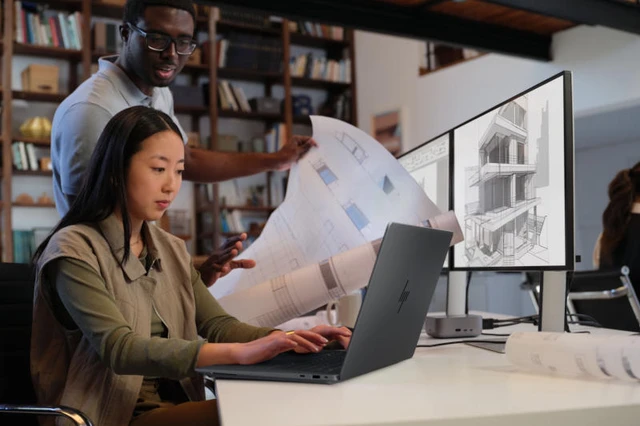
The device's software ecosystem is engineered for maximum privacy and autonomy. Integration with Perplexity Computer allows proprietary project data to be processed locally, eliminating the need for cloud transmission. Yet, flexibility remains: should a task require the resources of more powerful server clusters, the system can seamlessly pivot to a cloud-based model. For the professional segment, the machine provides robust support for resource-intensive applications such as Autodesk Revit 2027, 3ds Max, and Chaos Enscape. Of particular note is the MCP connector, which ensures seamless interaction between Perplexity Computer and Revit projects, transforming the AI into a fully integrated design assistant.
The visual experience is delivered via a 16-inch display available in several configurations. Users can choose between IPS panels with resolutions up to 4K (3840 × 2400) or a touch-enabled OLED screen with a resolution of 2880 × 1800. A 120 Hz refresh rate ensures the necessary fluidity when navigating graphics and the complex interfaces of professional software.
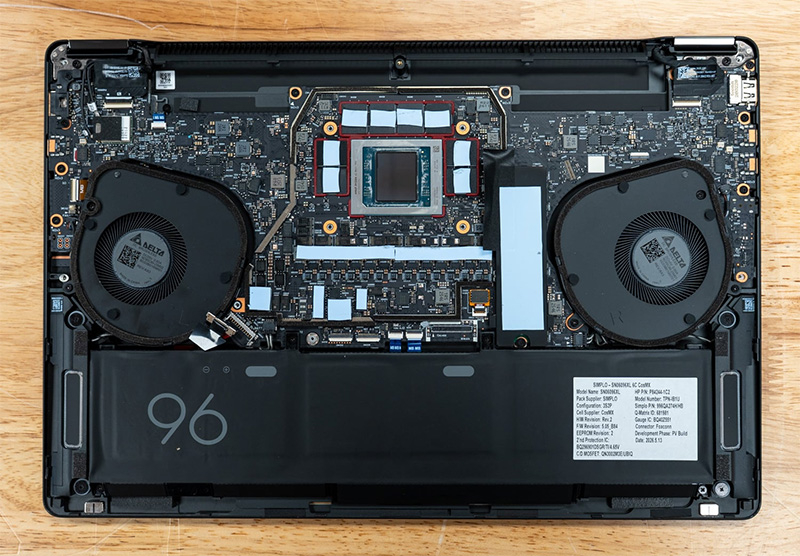
The primary engineering hurdle in creating such a device always comes down to thermodynamics. To manage a 100W Thermal Design Power (TDP)—nearly double that of previous generations—a massive cooling system was developed. A unified heat spreader covers both the processor and the memory modules, while two active fans exhaust heat through a radiator located at the rear of the chassis. Despite this power, the laptop maintains its mobility, with a thickness of 17.9 mm and a starting weight of 1.9 kg.
The hardware suite is rounded out by modern data transfer and power standards. It features a single M.2 PCIe 5.0 x4 slot supporting drives up to 8 TB, essential for storing the weights of large-scale neural networks. Power endurance is provided by a replaceable 96 Wh battery. The interface array includes two Thunderbolt 4 ports, HDMI 2.1, USB-C, and USB-A, while Wi-Fi 7 support and an optional 5G modem guarantee high-speed connectivity in any environment.
The device is expected to hit the market in October. While final LLM performance benchmarks await independent verification, the ZBook Ultra G3a 16 already stands as a manifesto for a new era—one where the power of a supercomputer is packaged into a portable form factor.
 Breaking the Lithography Barrier in China