The line between mobile and desktop computing is increasingly blurring. The MoDT (Mobile on Desktop) paradigm enables the integration of high-performance laptop silicon into a desktop form factor, presenting a compelling alternative to conventional custom builds. Colorful’s latest motherboard embodies this philosophy, pairing flagship Intel silicon with a pragmatic approach to memory architecture. This solution paves the way for a new generation of ultra-compact yet uncompromising workstations.
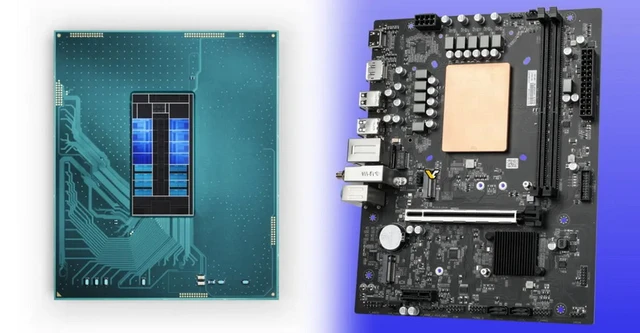
The hardware industry is increasingly pivoting toward hybrid form factors, and the arrival of the Colorful ECO HM770-K V20 is a prime example of this trend. The device is built upon the MoDT (Mobile on Desktop) philosophy, which integrates high-performance mobile processors directly onto a desktop motherboard's PCB. Unlike traditional LGA-socketed systems, where the CPU can be swapped by the user, the chip here is soldered. This approach optimizes power consumption and physical footprint while maintaining computational power comparable to full-fledged desktop solutions.
At the heart of the system lies the Intel Core i9-13900HX, the pinnacle of the Raptor Lake mobile lineup. This silicon features an impressive 24-core configuration, split between 8 performance cores (P-cores) and 16 efficient cores (E-cores). This hybrid architecture allows for highly efficient workload distribution: compute-intensive tasks and rendering are handled by the P-cores, while background processes are managed by the E-cores. With 32 threads, 36 MB of cache, and a Boost clock speed of up to 5.4 GHz, this processor transforms a compact board into a professional-grade workstation.
The model's positioning within the product lineup is particularly noteworthy. While the more premium BATTLE-AX series targets the DDR5 standard, the ECO version prioritizes DDR4 UDIMM support. The inclusion of two DDR4 slots is a strategic move to lower the overall cost of the build. Although DDR5 offers higher bandwidth, DDR4 remains a relevant and accessible standard that, in most real-world scenarios, will not act as a system bottleneck.
In terms of physical execution, the ECO HM770-K V20 occupies a middle ground between industry standards. While nominally classified as Micro-ATX, its actual dimensions (240 × 190 mm) make it noticeably narrower than standard boards in this segment. Its width closely approximates the Mini-ITX format, significantly expanding the options for selecting compact chassis for SFF (Small Form Factor) builds.
The board's technical feature set is on par with full-sized desktop solutions. Engineers have included a PCIe 5.0 x16 slot, ensuring forward compatibility with next-generation graphics cards and providing maximum data transfer speeds. An additional PCIe 4.0 x1 slot and two M.2 slots supporting NVMe PCIe 4.0 x4 allow for the creation of a high-speed storage subsystem, which is critical when working with massive datasets.
Networking capabilities and I/O interfaces align with modern business and gaming standards. The board features a 2.5Gb LAN controller, while wireless connectivity is handled by Wi-Fi 6E and Bluetooth 5.3 modules. The rear panel is equipped with four 5Gbps USB-A ports, and video output is provided via HDMI 2.0 and DisplayPort 1.2 interfaces. For front-panel peripherals, two internal USB-A headers are provided, making the board fully ready for integration into any modern system chassis.
 The Price of Acceleration: CXMT’s Rapid Push into Memory