For years, cutting-edge robotics remained the exclusive domain of secretive laboratories and tech giants. However, the rise of open-source programmable platforms is fundamentally shifting this landscape, transforming complex AI experimentation into an accessible toolkit for researchers and enthusiasts alike. Hugging Face is taking a decisive step in this evolution with the unveiling of Microduck, a compact bipedal robot. This device is engineered to serve as a bridge, closing the gap between the theoretical training of neural networks and their physical embodiment in the tangible world.
The emergence of Microduck marks a pivotal shift in Hugging Face's strategy: the company, which has effectively become the primary repository for LLMs and diffusion models, is now venturing into the realm of physical interaction. Developed in collaboration with the acquired Pollen Robotics and manufactured by Seeed Studio in Shenzhen, the robot is not merely a toy, but a comprehensive educational tool priced at $399.
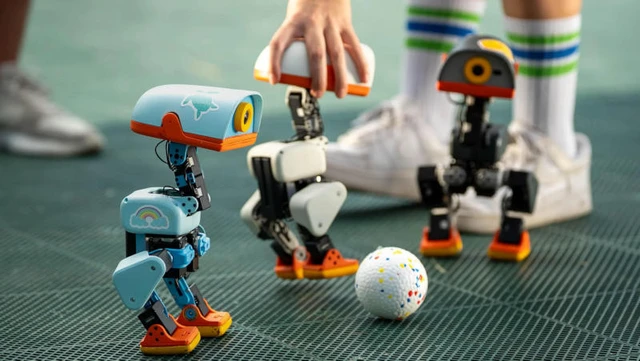
Visually, the device resembles a stylized duck, standing approximately 25 cm tall and weighing under 800 grams. Despite its minimalist aesthetic—featuring a single eye and a lack of traditional manipulators—the robot's functionality is powered by a sophisticated system of 15 electric motors. These drive the dynamics of the legs, head, and neck, as well as the articulated beak, which effectively serves as a gripper for manipulating small objects.
The approach to the interaction interface is particularly intriguing. The developers deliberately eschewed the imitation of human speech to avoid the "uncanny valley" and prevent the device from becoming just another voice assistant. Instead, Microduck employs a system of organic sounds to evoke the feeling of a living creature. Notably, each unit is assigned a unique sonic "personality" upon first boot, which persists throughout the device's lifecycle.
From a technical standpoint, Microduck is an open platform. The software stack is entirely open-source, and support for Python and JavaScript makes it accessible to a broad spectrum of developers. A cornerstone of the ecosystem is its integration with the MuJoCo simulator. This enables a classic Sim2Real pipeline: behavioral models are first trained in a virtual environment using Reinforcement Learning (RL) and subsequently deployed to the physical hardware, drastically reducing development cycles and the risk of equipment damage.
The robot's hardware provides comprehensive sensory awareness of its surroundings. Onboard components include a camera, microphone, speaker, LiDAR, and motion sensors, complemented by Wi-Fi and Bluetooth modules. To extend its capabilities, two NFC readers allow interaction with additional accessories, while a separate expansion kit is available for power users.
Out of the box, Microduck demonstrates an impressive array of baseline skills: from simple movements like squats and walking to more complex scenarios, including playing soccer or roller skating. The robot is capable of self-righting after a fall and following a laser pointer, showcasing the efficiency of its pre-installed balancing and navigation algorithms.
Hugging Face's strategic objective is to cultivate a mass community of roboticists. Plans to ship between 20,000 and 50,000 units signal an intent to establish Microduck as the industry standard for experimenting with collective agent behavior. The ability to group multiple robots for collaborative tasks paves the way for research into swarm intelligence and multi-agent systems—fields that were previously the exclusive domain of large-scale academic grants.
 iPhone 17: Dominating the Global Market