The global consumer electronics market is currently grappling with a systemic crisis triggered by a critical shortage of semiconductor components. A surge in memory chip pricing is compelling manufacturers to overhaul their pricing strategies, resulting in a palpable increase in retail costs. This volatility is most acute within the entry-level segment, where even marginal cost increments can prove catastrophic. Consequently, the industry finds itself caught in a precarious balancing act, forced to choose between safeguarding profit margins and ensuring the continued accessibility of technology.
The contemporary smartphone market is navigating a period of significant volatility, triggered by systemic disruptions in component supply chains. According to data from Counterpoint Research, retail prices for existing models have climbed by an average of 15% since the start of the year, while upcoming releases are projected to be 25% more expensive than their predecessors. In some extreme cases, device costs have even doubled, as manufacturers can no longer absorb the escalating costs of memory procurement and are forced to pass these expenses on to the end consumer.
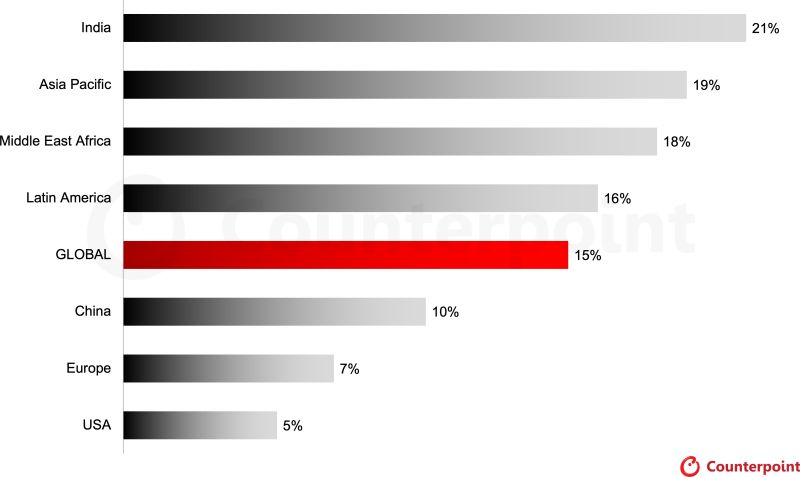
The geographic distribution of these price hikes is uneven and correlates closely with regional economic profiles. The most severe impact has been felt in markets traditionally dominated by budget-friendly models. In India, the average selling price has surged by 21%, followed by the Asia-Pacific region at 19%, and the Middle East and Africa at 18%. Latin America showed slightly more restrained dynamics with a 16% increase. In these regions, even marginal fluctuations in memory component costs significantly impact the final retail price, rendering devices less accessible to the mass market.
Conversely, mature markets with a high penetration of premium devices have proven more resilient. Price increases were limited to 10% in China, 7% in Europe, and a mere 5% in the US. This disparity is driven not only by the higher baseline cost of these devices—where memory represents a smaller fraction of the total price—but also by distribution specifics: sophisticated carrier subsidy frameworks help cushion price volatility for the end user.
Facing this pressure, vendors have pivoted toward strategies of forced optimization. To keep pricing within acceptable bounds, manufacturers are making hardware concessions: reducing onboard storage, simplifying camera configurations, and even reverting to 4G support instead of the more costly 5G in certain product lines. Effectively, the industry is entering a phase of "regressive evolution," where functionality is sacrificed on the altar of economic viability.
Consumer behavior is similarly transforming under these pressures. There is a noticeable extension of the device replacement cycle; users are upgrading less frequently, opting for base-model storage configurations, and increasingly turning to the pre-owned market. Simultaneously, there is a growing reliance on financing instruments and installment plans, which have become the primary means of managing the sharp spike in gadget costs.
Apple’s strategy is of particular note. Despite the fact that memory chip costs have quadrupled since late last year, the company has maintained stable pricing for the iPhone across most regions. While this approach preserves brand loyalty, it inevitably erodes operating margins. However, such a policy cannot persist indefinitely: analysts expect the upcoming iPhone 18 family to serve as the tipping point, with starting prices significantly higher than previous generations.

 The Evolution of Ultrabooks: Driven by Solid-State Cooling