The contemporary mobile device market is grappling with a critical challenge: the skyrocketing cost of memory components is directly driving up the retail price of flagship devices. Consequently, the pursuit of peak performance is shifting away from the brute-force expansion of hardware resources toward a paradigm of intelligent orchestration. Enter the MediaTek Dimensity 9600 Pro—a chipset engineered using a cutting-edge 2nm process. This processor heralds a new philosophy, leveraging artificial intelligence to optimize memory management, thereby achieving superior throughput while minimizing hardware overhead.
MediaTek's migration to TSMC's 2nm process represents more than a mere pursuit of numerical benchmarks; it is a strategic pivot toward maximizing energy density. By packing 33 billion transistors into an incredibly compact die, MediaTek has radically redefined its approach to power consumption and computational throughput. However, the true innovation lies in the shift from prioritizing raw memory capacity to optimizing the quality of its utilization.
Amidst the global surge in semiconductor memory costs, MediaTek has opted for a path of intelligent optimization. The integration of AI-driven mechanisms reduces the load on RAM, effectively minimizing the need for excessive capacity without compromising overall system velocity. This approach is becoming critical for smartphone manufacturers striving to curb the escalating costs of flagship models.
Particular emphasis has been placed on the Neural Processing Unit (NPU), which has emerged as a genuine performance catalyst. Comparisons with the previous generation reveal impressive gains: power consumption during AI model execution has plummeted by 40%, while overall computational speed has climbed by 50%. This translates directly into enhanced performance for Large Language Models (LLMs)—token generation is 40% faster, and local neural network boot times have been reduced by 27%, rendering the device virtually autonomous in its intelligent data processing.
The computational prowess of the Dimensity 9600 Pro is rooted in a hybrid "2+3+3" core configuration. At its heart lie two high-performance Arm C2-Ultra cores, complemented by three Arm C2-Pro cores featuring 1 MB of L2 cache, and another three Arm C2-Pro cores with 512 KB of L2 cache. A total increase in L2 cache volume of 21% has significantly mitigated data access latency.
Benchmark results validate the efficacy of this architecture. In single-threaded mode, the new chip outperforms its predecessor by 17% while delivering a 37% boost in power efficiency. In multi-threaded tasks, speed increases by 15%, though the most striking leap is seen in power efficiency, which has surged by 61%.
The hardware stack is further bolstered by support for the latest data transfer standards, LPDDR6 and UFS 5.0, ensuring maximum possible bandwidth between the processor and storage. The connectivity suite includes 5G support, the latest Wi-Fi iterations, and Bluetooth 6.2, guaranteeing the device's relevance for years to come.
The first devices powered by the Dimensity 9600 Pro from industry titans such as Samsung, Google, Xiaomi, Oppo, Vivo, and Amazon are expected to hit the market as early as October, marking the dawn of a new epoch of intelligent resource orchestration in the mobile segment.
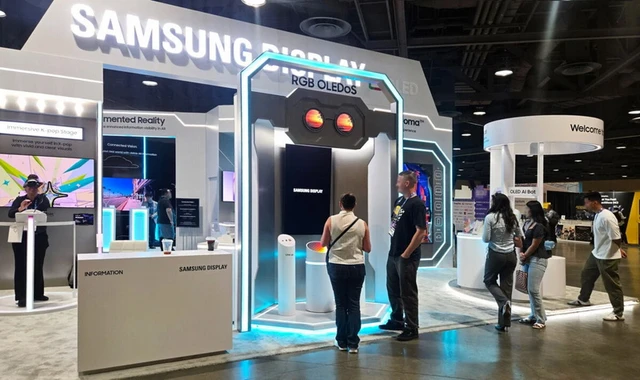 Samsung M16: A New Standard for OLED Panels