The race for local AI compute is entering a phase of radical scaling. Apple is meeting this challenge by pushing the boundaries of unified memory and semiconductor integration. The new Mac Studio is evolving beyond a mere workstation, transforming into a node within a distributed computing ecosystem. With the debut of the M5 Ultra chip, the company is doubling down on the professional segment, where the local execution of resource-intensive neural networks has become a critical priority.
Apple has unveiled its updated Mac Studio lineup, which retains the minimalist aesthetic of the 2022 design while masking a fundamental paradigm shift in performance. At the core of these new machines are the M5 Max and M5 Ultra chips, engineered to deliver unprecedented computational power within a compact form factor. Pricing begins at $2,499 for the M5 Max configuration and $5,499 for the flagship M5 Ultra.
The architectural centerpiece of the lineup is the M5 Ultra—the first quad-die processor in the history of Apple Silicon. Essentially, it is a fusion of two M5 Max chips linked via an ultra-high-speed interconnect with a bandwidth exceeding 4.4 TB/s. This architecture creates a unified compute space, allowing the CPU to scale up to 36 cores (comprising 12 "super-cores" and 24 performance cores) and the GPU up to 80 cores. Particular emphasis has been placed on neural processing: a dedicated neural accelerator is now integrated into every GPU core, resulting in a 4.3x increase in peak AI performance compared to the previous M3 Ultra generation.
Memory and storage have seen a quantum leap. While the M5 Max is capped at 128 GB of unified memory with a bandwidth of 614 GB/s, the M5 Ultra pushes the envelope to a staggering 512 GB. Data transfer speeds here reach 1.2 TB/s, a critical requirement for handling massive datasets that must be instantaneously accessible to both the CPU and GPU. Simultaneously, Apple has introduced PCIe 6.0 support for SSDs, effectively doubling the throughput of the storage subsystem.
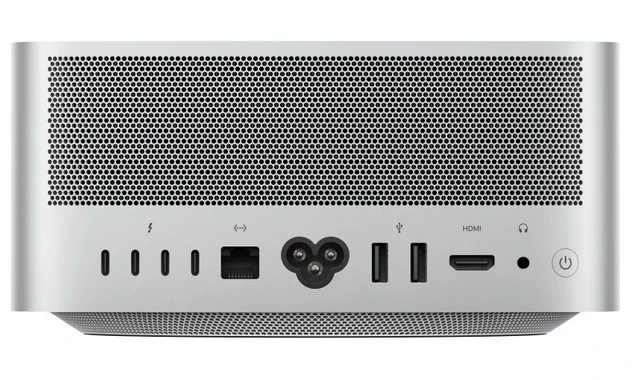
The connectivity suite is bolstered by the Apple N1 chip, providing support for Wi-Fi 7 and Bluetooth 6. Display capabilities have also been expanded: the system now supports up to eight displays or four professional Studio Display XDRs with 5K resolution at 120Hz. However, the most significant innovation is the inclusion of six Thunderbolt 5 ports, which now serve as more than just peripheral connectors—they are the gateway to creating full-scale compute clusters.
This marks Apple's transition from the concept of a singular powerhouse to the idea of distributed systems. Leveraging RDMA (Remote Direct Memory Access) technology, multiple Mac Studios can be linked into a single cluster. This allows systems to access each other's memory directly, forming a shared resource pool for running massive open-weight large language models (LLMs). According to available data, clustering four stations triples model inference speeds compared to a standalone system, positioning the Mac Studio as a formidable competitor to server-grade solutions for local AI deployment.
The software backbone for this hardware will be macOS 27 Golden Gate. Currently in beta, the OS will bring deep integration of Apple Intelligence and an overhauled Siri AI, transforming the operating system into a comprehensive intelligent assistant. The update is expected to launch this autumn, coinciding with the market release of the new Mac Studio and Mac Mini.
 The Economic Paradox of the GeForce RTX 5090