The race for exascale computing has entered a new, more intense chapter of technological confrontation. China’s LineShine system has unexpectedly surged to the summit of the TOP500, dethroning the American giants. This triumph represents far more than a mere incremental gain in raw performance; it signals a strategic pivot toward complete hardware sovereignty. In a world where access to cutting-edge semiconductors has been weaponized as a geopolitical lever, LineShine stands as a testament to the viability of a divergent technological trajectory.
The ISC 2026 conference in Hamburg has marked a paradigm shift in the landscape of high-performance computing. The 67th edition of the TOP500 rankings introduced a new global leader: LineShine. In a stunning ascent, the system stormed the top spot, displacing the long-standing favorite, the American supercomputer El Capitan. The High Performance Linpack (HPL) results signal a historic pivot, as China reclaims its status as the owner of the world's most powerful computing complex.
LineShine is the first system in history to officially breach the 2-Exaflop threshold in the Linpack benchmark. Its sustained double-precision performance reached 2.198 Exaflops, representing approximately 80% of its theoretical peak of 2.736 Exaflops. However, the true sensation is not the number itself, but the architecture behind it. In an era where the industry has almost entirely pivoted toward hybrid configurations leveraging massive GPU accelerators from Nvidia or AMD, LineShine relies exclusively on central processing units (CPUs).
The technical heart of the system, deployed at the National Supercomputing Center in Shenzhen (NSCS), is a masterclass in domestic engineering. It is built upon the LingKun platform and powered by custom Chinese LX2 processors. The scale is staggering: 13.79 million cores organized into 304-core modules clocked at 1.55 GHz. To ensure seamless data exchange, the system utilizes the proprietary LingQi interconnect, all managed under the Kylin operating system.
This architectural philosophy brings distinct trade-offs. This became evident in the mixed-precision HPL-MxP test, where LineShine posted a result of 7.92 Exaflops. A 3.6x acceleration over the classic HPL is modest compared to GPU-based systems, where the gap is often tenfold. This serves as direct confirmation that the system lacks dedicated accelerators, placing the entire computational burden on the CPUs. Nevertheless, in the HPCG benchmark—which more accurately reflects real-world application workloads—LineShine also secured first place with a result of 22.00 Pflops.
The power envelope of such a behemoth is inevitably massive, with consumption hovering around 42.2 MW. That said, its energy efficiency was recorded at 52.07 Gflops/W—a respectable figure for a system of this magnitude operating without specialized accelerators.
For China, this victory is the first since 2017, when the Sunway TaihuLight held the global lead. This return to the summit underscores the nation's strategic drive toward a vertically integrated electronics ecosystem, independent of Western vendors.
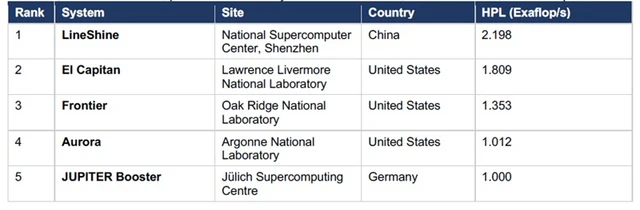
The current power dynamics of the top five are as follows:
- LineShine (China) — 2.198 Exaflops
- El Capitan (USA) — 1.809 Exaflops
- Frontier (USA) — 1.353 Exaflops
- Aurora (USA) — 1.012 Exaflops
- JUPITER Booster (Germany) — 1.000 Exaflops
Notably, Italy's HPC7, operated by Eni S.p.A., has entered the top ten with a performance of 571.5 Pflops. Built on the HPE Cray EX255a platform using AMD Instinct MI300A chips, it confirms the dominance of this specific hardware stack within the European segment.
Looking at the broader picture, the United States maintains its lead in the total number of supercomputers on the list, although its count has decreased by ten units compared to November 2025. China, conversely, has adopted a strategy of concentrated power: with only 30 systems (ranking fourth in quantity behind the US, Germany, and Japan), it possesses the second-largest aggregate computing capacity in the world. This indicates a strategic transition from quantitative expansion to the creation of ultra-powerful, technologically autonomous nodes.
 The Economic Paradox of the GeForce RTX 5090