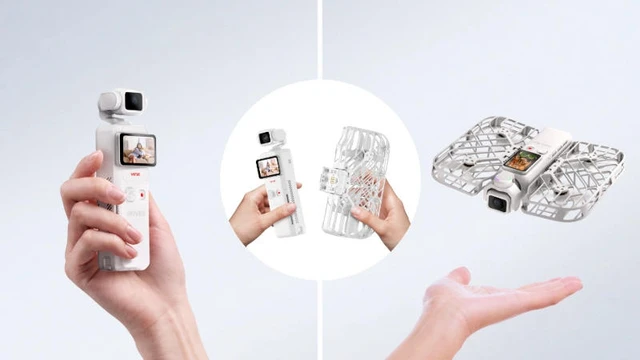
The global unmanned systems market has evolved into a high-stakes battleground where rapid technological advancement clashes with the imperatives of national security. In the United States, regulatory bodies are tightening their grip on foreign drone imports, aiming to curb the influence of overseas manufacturers within the domestic market. Under these pressures, companies are being forced to explore unconventional strategies to maintain a legal foothold in the country. The case of the HoverAir Versa illustrates just how razor-thin the line can be between a consumer-grade gadget and a target of government prohibition.
The contemporary US regulatory landscape is increasingly defined by a climate of skepticism toward foreign technology, particularly within the unmanned aerial vehicle (UAV) sector. Toward the end of last year, the Federal Communications Commission (FCC) effectively shuttered market access for foreign-made drones and the components essential to their production. This move was precipitated by mounting concerns over data security and the potential weaponization of radio equipment against national security interests.
In response to these headwinds, Zero Zero Robotics has employed a strategy that can only be described as legal acrobatics. Rather than attempting to market a fully realized drone, the company introduced the HoverAir Versa—a device officially positioned not as a UAV, but as a compact "mini-steadicam." The linchpin of this maneuver is the use of detachable propellers, which are categorized not as integral parts of the device, but as optional accessories designed to expand its functionality.
From the manufacturer's perspective, this product decomposition allows the HoverAir Versa to remain technically compliant with current regulatory frameworks. The logic is straightforward: if the primary product is classified as a camera, it falls under the category of permitted equipment. The propellers then become an optional add-on, acquired at the consumer's discretion. At first glance, the gambit appears successful; the FCC granted approval, clearing the way for the company to launch its crowdfunding campaign on Indiegogo.
However, the technical and legal reality is far more nuanced. The crux of the issue lies in how the FCC classifies radio-frequency (RF) equipment. While most cameras bypass stringent restrictions, UAVs and their critical components are subject to rigorous oversight. In the case of the HoverAir Versa, the radio module is integrated directly into the camera, while the propellers connect via copper contacts and possess no independent RF capabilities. Consequently, the "heart" of the device—the camera—is precisely the piece of radio equipment subject to commission regulation.
There is a significant risk that the FCC may revisit its decision. Should the regulator determine that the HoverAir Versa camera constitutes a "critical UAV component," the authorization could be revoked shortly after issuance. Essentially, the company's entire business model hinges on a precarious interpretation of the term "accessory."
Market demand further underscores that consumers are interested in the device's flight capabilities rather than mere image stabilization. Indiegogo statistics reveal that the vast majority of backers opted for the bundle including propellers, with only a handful interested in the camera as a standalone, static device. This highlights a fundamental conflict between the product's marketing veneer and its actual utility in the eyes of both the user and the regulator.
 The Price of Acceleration: CXMT’s Rapid Push into Memory