The Edge AI market is currently undergoing a period of rapid transformation, as edge computing power becomes a mission-critical resource for robotics and autonomous systems. Nvidia maintains a commanding lead in this segment, positioning its Jetson ecosystem as the industry gold standard. However, an abrupt and aggressive overhaul of the company's pricing policy has sparked significant concern across the professional community. This sudden spike in hardware costs, implemented without prior notice, suggests either profound structural shifts within the supply chain or a fundamental pivot in the tech giant's market strategy.
The edge computing landscape has been blindsided by an aggressive pricing overhaul across Nvidia's entire Jetson family. This revision extends beyond basic developer kits to include the full-scale production modules essential for the mass manufacturing of intelligent devices. Notably, Nvidia executed this move with total stealth—foregoing official notifications or transition periods—simply updating the price lists on its website and presenting customers with a fait accompli.
The scale of these adjustments is uncompromisingly stark, with some line items more than doubling in cost. For instance, the Jetson Orin Nano Super Developer Kit—the primary entry point into the ecosystem—has seen a 60% surge, climbing from $249 to $399. High-performance solutions were hit even harder: the AGX Orin kit now commands $3,499, up from $1,999, while the flagship Jetson AGX Thor, designed for complex autonomy and humanoid robotics, has leaped from $3,499 to $5,499.
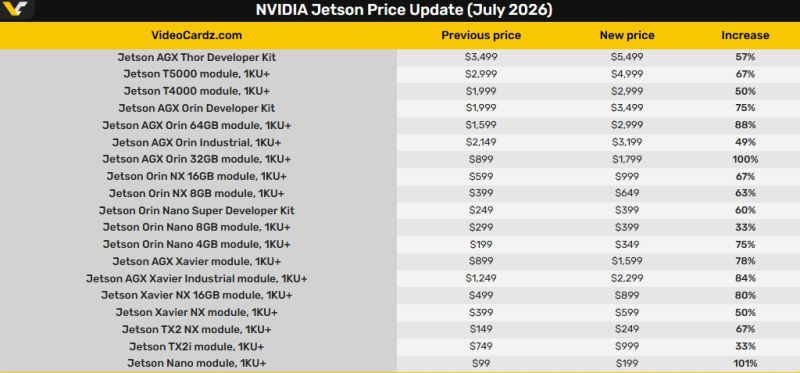
The most severe impact is felt by production modules, the bedrock of commercial hardware products. The costs for the Jetson Nano and the 32GB AGX Orin have effectively doubled. The 64GB AGX Orin module saw an 88% increase, reaching $2,999. Even battle-tested legacy solutions, such as the Xavier Industrial and the 16GB Xavier NX, were not spared, with prices climbing by 80–84%.
Such volatile pricing is anomalous for a mature product line and raises serious questions regarding the catalyst behind this move. While Nvidia has offered no official explanation, the technical context suggests a clear narrative: a critical shortage of specialized memory (LPDDR5/HBM) used in Jetson modules. Amidst the global generative AI boom and the insatiable demand for data center GPUs, high-speed memory production capacity has become a bottleneck.
It appears Nvidia is shifting its priorities toward maximum-margin cloud computing products, indirectly marginalizing the Edge AI segment. For developers and startups, this translates to a significant increase in the cost of prototyping and scaling, potentially stifling the pace at which intelligent systems are deployed across real-world industrial sectors.
 Energy Autonomy: The Extreme Edition