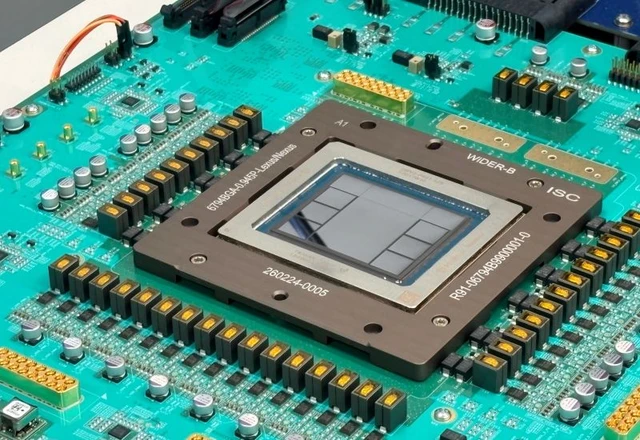
The global AI arms race is shifting its focus from the realm of algorithms to the domain of hardware. Driven by a quest for total autonomy, industry leaders are developing proprietary semiconductor solutions to break their reliance on market monopolists. OpenAI is taking a decisive step toward vertical integration, unveiling the performance benchmarks of its specialized chip, Jalapeno. This strategic pivot promises to radically transform the cost and latency of neural networks by optimizing the most precious resource of the modern era: power consumption.
For too long, the modern AI market has been beholden to a single supplier, where access to compute power dictated the pace of technological evolution. OpenAI, in partnership with Broadcom, is now rewriting the rules of the game with the development of its own accelerator, Jalapeno. This project is the result of an ambitious drive toward infrastructure optimization—and ironically, the chip's own design process was accelerated by AI models.
Initial benchmarks reveal impressive results. In a direct head-to-head with Nvidia’s current flagship, the Blackwell-based GB300, Jalapeno demonstrated superiority across two critical metrics: performance-per-watt and latency. In the semiconductor industry, it is rare to simultaneously improve both energy efficiency and response times, as these factors typically exist in a state of compromise. Jalapeno has broken this barrier, paving the way for more responsive end-user interfaces.
It is crucial to understand the fundamental difference in the device's purpose. While Nvidia's solutions are versatile and indispensable for large-scale model training, Jalapeno is strictly optimized for inference—the process of executing a pre-trained model to generate responses. Inference is where the bulk of a company's operational expenditures are concentrated. By capping power consumption at 700W per chip, OpenAI can significantly reduce electricity and cooling costs for its data centers, which will eventually lead to lower API pricing for clients or increased content generation speeds.
OpenAI’s strategy does not imply a total pivot away from third-party vendors; instead, the company is evolving into a hybrid ecosystem. Compact models may still leverage Cerebras solutions, while Nvidia remains the standard for heavy training and general-purpose tasks. Jalapeno carves out its own niche, ensuring the scalability of large models with minimal overhead.
The chip was tested across a broad spectrum of tasks, ranging from small open-source models to complex systems like DeepSeek and Moonshot AI. The most significant efficiency gains were observed with Moonshot AI, confirming the high adaptability of the new silicon. Furthermore, internal tests on OpenAI's yet-to-be-released frontier models have also yielded excellent results.
The development of Jalapeno is only the beginning of a long journey. Work is already underway on a second generation of chips, expected to be completed in the coming months, and the design phase for the third generation has already been initiated. The objective remains constant: minimizing the energy footprint and achieving full technological sovereignty. By bringing these developments into the public eye, OpenAI aims to stimulate the broader semiconductor innovation landscape, transforming a closed arms race into open technological progress.
 The Speed Limits of Modern Gaming Displays