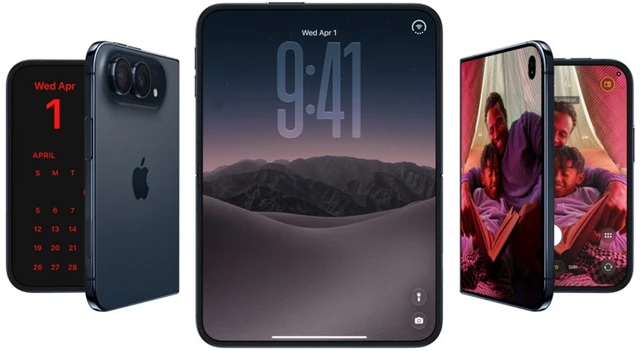
For years, the industry has anticipated Apple's foray into the foldable market, closely monitoring the experimental efforts of its competitors. The debut of the iPhone Duo signals a shift away from mere iterative updates toward a fundamental reimagining of how we interact with mobile interfaces. This is far more than a technical exercise in flexible glass; it is a sophisticated engineering response to the demand for convergence between the smartphone and the tablet. Apple is now presenting a new vision of productivity—one where the physical form of the device directly dictates its operational utility.
Apple has unveiled the iPhone Duo—a device that fundamentally disrupts the traditional evolutionary trajectory of the iPhone lineup. Its compact, "passport-style" form factor is tailored for users who find a standard screen insufficient for content creation and professional workflows, yet are unwilling to carry a full-sized tablet. The chassis is built around a titanium frame, ensuring critical structural rigidity while maintaining a premium haptic experience, while the A20 Pro chip provides the raw computational power.
The visual experience of the Duo is delivered in two distinct stages. In its folded configuration, the user interacts with a 5.4-inch OLED display—nearly identical in surface area to the iPhone 18 Pro—making it a fully capable tool for rapid tasks. However, its true potential is unleashed upon unfolding, revealing a 7.6-inch Super Retina XDR panel. This screen is 80% larger than that of the base Pro model, effectively transforming the smartphone into a compact media hub. Of particular note is the anti-reflective nano-texture coating on the internal display, crafted via maskless laser lithography—a sophisticated technique that minimizes reflections without compromising contrast. Durability is handled by a combination of Ceramic Shield and the updated Ceramic Shield 2; together with an IP68 rating, these ensure the device is resilient against environmental stressors.
The engineering prowess of the Duo is concentrated in its hinge mechanism, which comprises over 100 precision-engineered components. To prevent panel deformation over thousands of fold cycles, Apple has implemented a multi-layered screen architecture supported by carbon-fiber reinforcement plates. Despite this technological leap, the device remains substantial: weighing 254 grams and measuring 11.3 mm thick when folded, it is noticeably heavier and bulkier than Samsung's counterparts. This suggests a strategic priority on the part of Apple toward structural integrity and long-term durability.
On the software front, iOS has undergone a comprehensive overhaul to support dynamic chassis orientations. The interface now transitions fluidly from the external screen to the internal one, with control elements adapting in real-time to the angle of deployment. Full-scale multitasking has been implemented, allowing users to run two applications simultaneously or open dual instances of a single service (such as Slack or Zoom), turning the Duo into a highly efficient productivity tool.
At the core of the device lies the A20 Pro processor, which features a dedicated GPU architecture optimized for dual-display management. This module is responsible for the seamless transitions and image synchronization during the unfolding process. Parallel to this, the integration of the C2 modem not only boosts 5G mmWave data transfer speeds by 50% over the previous generation but also reduces power consumption by 15%.
The iPhone Duo utilizes a hybrid power system: two separate batteries operating as a single unified cell. Battery life ranges from 24 hours under mixed-use scenarios to 44 hours when operating exclusively via the external screen. A high-speed charging system allows the device to recover half its capacity in just 20 minutes—a critical feature for a device sporting such an energy-intensive display.
The imaging system of the Duo blends traditional excellence with cutting-edge innovation. The primary array consists of two 48MP Fusion modules, delivering high-fidelity imagery and seamless 2x optical zoom. The external screen's front-facing camera is derived from the proven solutions of the iPhone 18 Pro, while the internal FaceTime camera is completely concealed under the display, preserving the visual integrity of the panel. A standout addition is the Smart Take feature, which transforms the smartphone into a self-sufficient tripod capable of autonomously tracking a scene to capture the perfect moment.
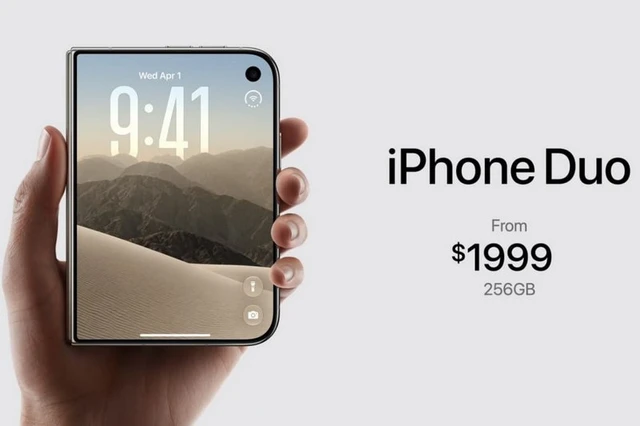
The market positioning of the iPhone Duo reinforces its status as a luxury-tier product. Pricing for the entry-level 256GB configuration starts at $1,999, while the top-tier 2TB model reaches $3,199. The device is scheduled for release in October, positioning it as the definitive technological event of the autumn season.
 A Comprehensive Refresh of Apple's Global Product Portfolio