Modern cybersecurity has traditionally centered on hardening software code and implementing robust data encryption. Yet, the inherent physics of hardware introduces vulnerabilities that no routine system update can patch. Researchers have uncovered a method to intercept user activity by analyzing a device's electromagnetic emissions. By transforming a smartphone's power consumption patterns into a unique behavioral signature, this technique effectively bypasses all software-level security restrictions.
In the realm of cybersecurity, there is a concept known as "side-channel attacks." While most experts focus on hunting for vulnerabilities in operating systems or attempting to crack encryption protocols, the physical layer of a device often remains a critical blind spot. This is precisely where researchers from the People's Public Security University of China have identified a breach, proposing a surveillance method that renders even the most stringent privacy settings obsolete.
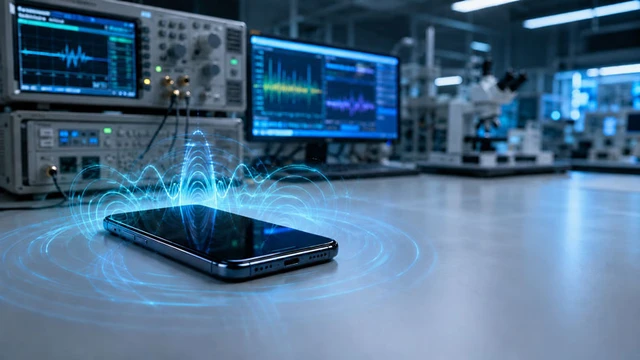
The core of the issue lies in the fundamental laws of electrodynamics. Every action performed on a smartphone—whether sending a message or launching a resource-intensive game—imposes a specific load on the hardware architecture. The CPU, GPU, Wi-Fi and GPS modules, and memory controllers consume power inconsistently. These fluctuations in power draw inevitably generate low-frequency electromagnetic radiation, which essentially serves as an "echo" of the operations being executed.
To intercept these signals, the researchers employed an external electromagnetic induction coil tuned to a frequency range of 150 to 650 kHz. The resulting data manifests as complex spectral noise—chaotic to the human eye, but a distinct "fingerprint" to artificial intelligence algorithms. A trained neural network can map specific radiation patterns to a particular application or user action.
The efficacy of this method was validated across various ecosystems, including the iPhone 15 Pro, Xiaomi 15 Pro, and Oppo Reno 13. The results were striking: the accuracy of recognizing launched applications—such as Douyin, WeChat, Baidu Maps, or a web browser—reached 99.07%. Furthermore, the system could discern granular behavioral shifts within a single service. For instance, while a user watched videos on YouTube or Bilibili, the AI determined with 95.61% accuracy whether the user paused the video, hit play, or increased the playback speed.
The most alarming aspect of this technology is its complete software independence. Because the method relies on physical leakages, it remains effective in scenarios previously deemed secure: when the smartphone is locked, disconnected from all networks, or even set to airplane mode. In such a scenario, the device is transformed into a passive transmitter, broadcasting the owner's actions to anyone equipped with the appropriate receiving hardware.
From a practical standpoint, the authors of the study emphasize applications in forensics and digital investigations. The ability to obtain independent confirmation that a specific app was running—without the need to physically breach the memory or gain access to cloud backups—significantly expands the available forensic evidence. However, this also presents a more global threat: the potential for the covert construction of detailed behavioral profiles.
Nevertheless, the technology currently faces significant limitations. All successful tests were conducted in controlled lab environments with minimal distance between the sensor and the smartphone. In the real world, amidst dense urban infrastructure, protective cases, and a deluge of electromagnetic interference from other devices, reading accuracy may drop sharply. However, the history of Signals Intelligence (SIGINT) suggests that such limitations are typically overcome over time through the development of more sensitive antennas and the refinement of noise-reduction algorithms.
 iPhone 17: Dominating the Global Market