The boundary between software and hardware is dissolving as AI agents evolve beyond chat windows to assume direct control over real-world processes. The collaboration between OpenAI and Work Louder marks a significant shift in the industry's trajectory toward specialized tactile interfaces for developers. Codex Micro is not merely a peripheral; it is a sophisticated command center engineered for the orchestration of complex autonomous systems. The rapid success of this limited release validates an escalating market demand for tools that minimize cognitive friction when interfacing with artificial intelligence.
In modern software engineering, the concept of AI agency marks a paradigm shift from basic prompt-response interactions toward the execution of complex, multi-step autonomous tasks. However, managing such systems via standard text interfaces often leads to cognitive overload and incessant context switching. This friction served as the catalyst for Codex Micro—a compact mechanical device developed by OpenAI in collaboration with experts from Work Louder.
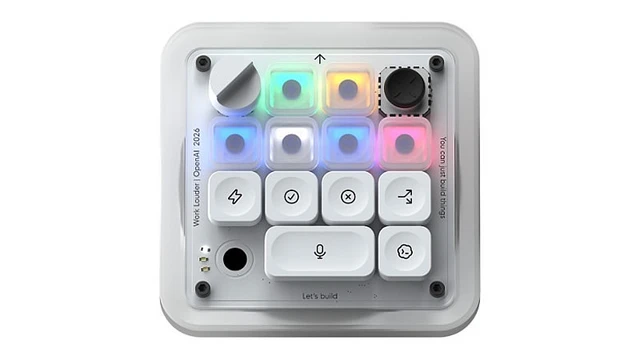
The device is engineered as a physical bridge between the developer and the Codex agentic system. Rather than relying solely on keyboard shortcuts or graphical user interfaces, users are provided with a dedicated control instrument. The hardware configuration features 13 mechanical keys, a joystick, a rotary encoder, and a touch sensor. With interchangeable keycaps, the device can be tailored to specific workflows, effectively transforming it into an ergonomic command center for code management.
Particularly noteworthy is the implementation of visual feedback via six dedicated RGB-backlit "Agent Keys." In the era of autonomous agents, maintaining situational awareness of the system's state without breaking a developer's flow is critical. These indicators allow for an instantaneous determination of whether the agent is in a reasoning phase, awaiting user confirmation, executing an active task, or encountering a system error. This approach radically reduces context-switching overhead and enhances overall development efficiency.
The market response to Codex Micro was instantaneous: the entire limited run sold out in less than 24 hours. Despite its premium price point of $230, demand far outstripped supply, signaling the professional community's readiness to invest in specialized hardware for neural network interaction. This case highlights the emergence of a new "AI-native hardware" segment—devices designed not merely as computer peripherals, but as organic extensions of intelligent control systems.
 Intel’s Strategic Play for Advanced Packaging Supremacy