Bridging the divide between air and water has long remained one of the most formidable challenges in modern robotics, driven by the stark disparity in density between these two mediums. Conventional platforms are typically tethered to a single domain; those that attempt to bridge both often suffer from a cumbersome mass that strips them of their agility. The breakthrough lies in a biomimetic approach, drawing inspiration from the evolutionary mechanics of diving birds. The creation of this lightweight hybrid drone heralds a new era in autonomous oceanic monitoring, seamlessly integrating aerial velocity with the capacity for efficient submersion.
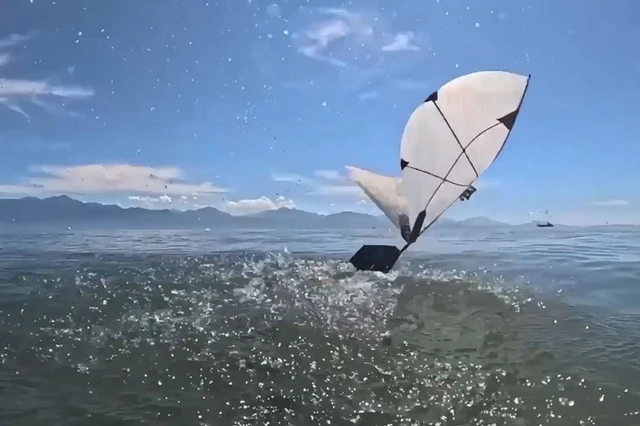
In the realm of modern engineering, the pursuit of a truly versatile dual-medium vehicle often collides with a fundamental physical paradox: the mechanisms optimized for lift in rarefied air are frequently ineffective—or even counterproductive—within the dense medium of water. However, researchers from the Massachusetts Institute of Technology (MIT) and the École Polytechnique Fédérale de Lausanne (EPFL) have proposed an elegant solution by looking to nature's own prototypes: puffins and storm petrels. The result of this work is the FAAV (flapping-wing aerial-aquatic vehicle), a compact craft that utilizes a flapping-wing mechanism to navigate both the skies and the depths.
The technical execution of the FAAV is a masterclass in minimalism and functional efficiency. Weighing under 300 grams, the robot features a hermetically sealed fuselage housing its battery and electric motor. At its core lies a crank mechanism that translates the motor's rotation into rhythmic wing beats. Material science plays a pivotal role here: the wing membranes are coated with a specialized hydrophobic nanolayer. This critical detail allows the craft to shed water instantaneously upon surfacing, preventing weight gain and preserving its aerodynamic integrity.
A primary engineering challenge lay in the optimization of the wingspan. Through a series of experiments conducted in laboratory tanks and the open waters of Lake Geneva, researchers tested three configurations: 60, 80, and 100 centimeters. The 80 cm variant emerged as the optimal balance, providing the necessary flexibility for the high-density aquatic environment—where movement amplitude must be constrained—while maintaining sufficient rigidity to generate lift in the air. Consequently, the robot achieved speeds of approximately 1 m/s underwater and accelerated to 6 m/s upon takeoff.
The transition from water to air represents the most energy-intensive and precarious phase of operation. Engineers identified the angle of attack as the critical variable, determining that the optimal surface exit occurs at an incline of approximately 70°. An angle too shallow prevents a clean break from the water's surface, while one too steep risks capsizing the craft. Notably, the FAAV outperforms many avian species in this regard; it requires no auxiliary thrust from legs, generating all the necessary lift exclusively through wing oscillation and tail stabilization.
From a scientific perspective, the FAAV demonstrates the feasibility of controlling a vehicle across media with a density differential of nearly a thousandfold, utilizing a single actuation mechanism. This breakthrough opens significant vistas for oceanography and marine biology. Future iterations are expected to incorporate thrust vectoring systems and undergo testing in extreme conditions, including storms and high-velocity winds.
Such autonomous systems possess the potential to radically redefine field research methodologies. Rather than relying on cumbersome vessels, scientists could deploy swarms of lightweight drones capable of rapidly reaching remote icebergs or marine wildlife clusters, diving for sampling and precision measurements, and returning data to base. This approach would not only drastically reduce operational timelines but also minimize the anthropogenic footprint on fragile marine ecosystems.
 Flexible Silicon in a Polymer Shell