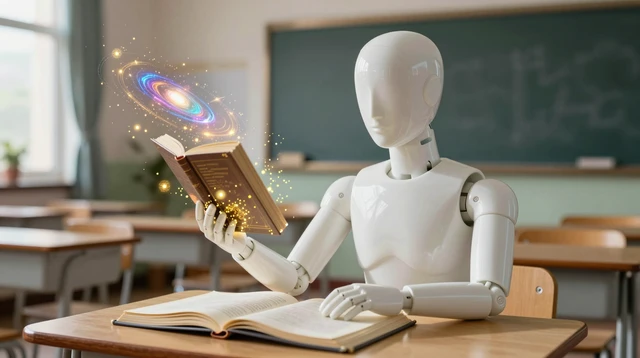
The global educational paradigm is undergoing a fundamental shift; artificial intelligence is evolving from a mere retrieval tool into an active participant in the pedagogical process. In rural New York, this transition has taken a tangible form: anthropomorphic robots. The attempt to integrate humanoid assistants into the classroom sparks critical debates over the digital divide, ethics, and the permissible boundaries of automated instruction. This experiment serves as a litmus test for how cutting-edge technology adapts to nuanced social landscapes.
The Salamanca City school district in western New York is launching an ambitious pilot featuring Sally—a humanoid AI assistant equipped with silicone skin and a sophisticated range of facial expressions. Unlike traditional educational software confined to a screen, Sally establishes a tangible physical presence in the classroom. Despite her static position, the robot utilizes active gesturing and emotive facial shifts designed to foster a more natural emotional bond with students.
The project’s technical architecture relies on a hybrid interaction model: Sally’s physical chassis works in tandem with a virtual avatar hosted on students' laptops. Personalization is managed via unique identification codes, allowing the AI to instantaneously retrieve previous dialogue contexts and load individual student data. While the robot handles emotional and visual engagement, the digital avatar manages the routine cognitive heavy lifting—grading assignments via photo analysis, generating supplementary materials, and providing real-time translation across more than one hundred languages.
The pilot focuses on high school robotics and AI courses based on the Steve Wozniak curriculum. This choice is deliberate: leveraging the methodologies of the Apple co-founder underscores the district's commitment to providing students with cutting-edge engineering knowledge. At the heart of this approach lies a philosophy of deep pragmatism; the administration has consciously rejected a policy of prohibition, believing that teaching students how to interact correctly with technology is far more effective than attempting to block it entirely.
However, introducing high-tech solutions into a conservative rural environment inevitably sparks social tension. The Salamanca City district is characterized by a high proportion of low-income families and a significant presence of the indigenous Seneca Nation. For this community, the arrival of an "alien" AI has raised serious concerns. To mitigate these risks, developers have implemented a rigorous security protocol: the system operates entirely offline to prevent data leaks to external networks and is trained strictly on the local curriculum. Furthermore, the algorithms are tuned to combat AI "hallucinations"—rather than fabricating answers when data is missing, the robot is programmed to candidly admit its ignorance.
The financial implications are also a point of contention. The implementation cost totaled $57,590—a substantial sum for a rural budget. Yet, the primary concern is the reputational track record of the manufacturer, Realbotix. The company was previously known for creating hyper-realistic sex dolls and adult companion robots. Despite assertions that the educational division is entirely separate in terms of business structure, personnel, and technology from the core business, this legacy creates a palpable ethical dissonance.
From a strategic development perspective, the Sally project is viewed as a tool to combat rural decay. There is a compelling argument that demonstrating the accessibility of high technology within one's hometown can stem the brain drain of talented youth to major metropolitan areas. In today's climate, ignoring AI effectively condemns graduates to future competitive obsolescence. Ultimately, the success of this experiment will be measured not by technical metrics, but by how organically a synthetic persona can integrate into the living fabric of human education—not by replacing the teacher, but by augmenting their capabilities.
 Energy Autonomy: The Extreme Edition