Mars remains one of the most enigmatic and least explored chapters in the history of our solar system. Every revelation brought back by NASA’s rovers compels scientists to recalibrate established paradigms regarding the Red Planet's geological evolution. A recent discovery by the Curiosity rover on the slopes of Mount Sharp has presented researchers with a formidable challenge: interpreting anomalous topographical features. These structures, reminiscent of colossal imprints, are proving pivotal in decoding the processes of erosion and chemical metamorphosis within the Martian bedrock.
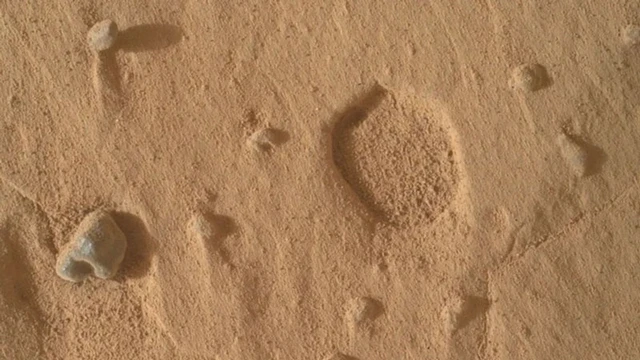
Within Gale Crater, along the slopes of the imposing Mount Sharp, the Curiosity rover has documented a series of anomalous morphological formations. These wide, unexpectedly shallow depressions in the bedrock bear a striking visual resemblance to massive footprints. While the similarity to biological tracks is provocative, the scientific community has dismissed any hypothesis of extraterrestrial life; instead, these are the products of complex geological processes whose nature remains an enigma.
The intrigue of these structures lies in their specific geometry and environmental context. While minor pits and caverns are commonplace across the Martian landscape, these formations are distinguished by their significant surface area coupled with minimal depth. Furthermore, detailed analysis of the surrounding terrain revealed a total absence of any objects capable of leaving such impressions. There are no signs of weathering around large boulders nor remnants of collapsed rock, effectively ruling out standard erosional scenarios. This compels researchers to seek a fundamentally different mechanism of relief formation—one capable of sculpting such shapes without the intervention of external physical bodies.
To dissect these anomalies, Curiosity deployed its full suite of scientific instrumentation. The MAHLI camera provided a microscopic perspective on the surface texture, capturing the finest details of the rock's structure. The Mastcam system provided the necessary spatial context, capturing wide-angle panoramas to determine the scale and distribution of these "prints." Simultaneously, ChemCam and the Alpha Particle X-Ray Spectrometer (APXS) performed an exhaustive chemical analysis of the material.
The spectrometric data proved highly revealing. Pronounced stratified structures were detected within the depressions, and the chemical composition of the material differs significantly from that of the surrounding bedrock. This suggests that we are not merely observing mechanical surface damage, but rather the result of profound chemical or thermal transformations.
At present, researchers cannot pinpoint the exact timeframe of these structures' emergence or the precise physicochemical process that birthed them. Nevertheless, this discovery is fundamental to reconstructing the geological history of Mars. The compositional variance between the interior and exterior of these "prints" may point to specific weathering or erosion cycles that occurred millions of years ago. Deciphering the genesis of these structures will allow for a more accurate reconstruction of the climatic and geological conditions that prevailed in the Mount Sharp region in the distant past.
 The Orbital Leap of the Starship System