The boundary between biological evolution and digital engineering has effectively dissolved. For the first time, generative artificial intelligence has transcended the realms of text and imagery to synthesize functional genetic code capable of infiltrating living organisms. This leap in synthetic biology heralds a new era of precision medicine and targeted antimicrobial therapies; yet, it simultaneously confronts humanity with pressing ethical dilemmas regarding the accessibility of tools for pathogen design.
Contemporary synthetic biology has evolved from the mere replication of natural mechanisms to their comprehensive engineering. A recent experiment by a team of American researchers has demonstrated that a specialized artificial intelligence model is capable of designing fully functional viral genomes from scratch. The result was 16 viable structures that successfully infected bacteria in laboratory settings, confirming their biological functionality.
At the heart of this breakthrough are the Evo 1 and Evo 2 genomic language models. Their operation is based on principles similar to those of Large Language Models (LLMs); however, instead of predicting the next word in a sentence, the AI operates on DNA nucleotide sequences. The system was trained on a colossal dataset—over two million phage genomes—followed by deep fine-tuning on 14,466 sequences from the Microviridae family of bacteriophages.
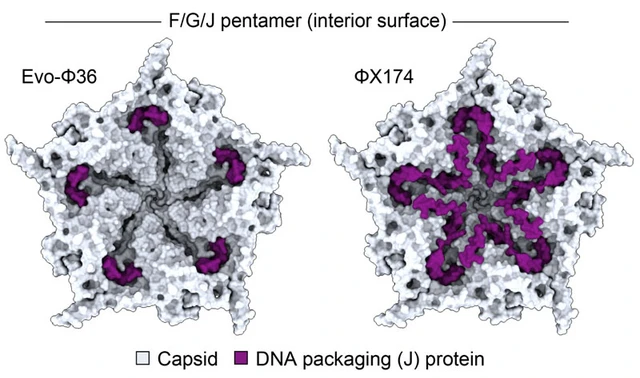
The researchers selected the bacteriophage $\Phi X174$ as the base template. This virus holds a distinguished place in scientific history: it was the first genome to be fully sequenced in 1977 and one of the first to be chemically synthesized in 2003. Its compact architecture—consisting of just 5,386 nucleotides and 11 genes—made it an ideal proving ground for testing the capabilities of generative AI.
The process of creating these new viruses functioned as a multi-tiered filtration system. First, the neural network generated thousands of genomic variants, from which researchers selected the most promising sequences based on structural criteria and their predicted ability to infect a specific laboratory strain of Escherichia coli C. Particular emphasis was placed on specificity: the synthetic viruses had to target only the intended object without affecting other organisms.
Following the computational modeling phase, several hundred selected genomes were synthesized into DNA and subjected to experimental validation. Out of 285 tested constructs, 16 proved viable. These artificial bacteriophages successfully replicated within the target bacteria, inducing lysis—the complete destruction of the pathogen's cell wall.
The most compelling dimension of the study was the degree to which the synthetic viruses diverged from their natural prototypes. Some samples exhibited between 67 and 392 novel mutations compared to their closest natural relatives. One specific variant, Evo-$\Phi 2147$, showed only 93% similarity to the known phage NC51. From the perspective of classical biology, this level of divergence allows it to be classified as a distinct species that previously did not exist in nature.
The practical potential of this technology is immense. Amidst the global crisis of antimicrobial resistance, where traditional drugs are failing against "superbugs," the ability to engineer targeted bacteriophages may become our primary recourse. This paves the way for personalized antiviral therapies and novel methods of safeguarding human health.
However, such a technological triumph inevitably brings existential risks. The capacity for AI to design viable viruses implies that the creation of pathogens lethal to humans is now theoretically possible. Despite assurances of total control over the process, the history of high-tech development shows that any dual-use tool will eventually be weaponized if safety mechanisms do not outpace the rate of innovation.
 Anthropic’s Strategic Push for Hardware Independence