The mobile industry is currently undergoing one of its most profound transformations in a decade, pivoting from traditional user interfaces toward the era of generative AI. Features that were viewed as exotic novelties reserved for flagship devices are rapidly evolving into the new industry baseline. Yet, this trajectory is hampered by global component shortages and the inherent inertia of established user behaviors. The next two years will be decisive in determining whether on-device AI emerges as a genuine productivity catalyst or remains a mere marketing gimmick.
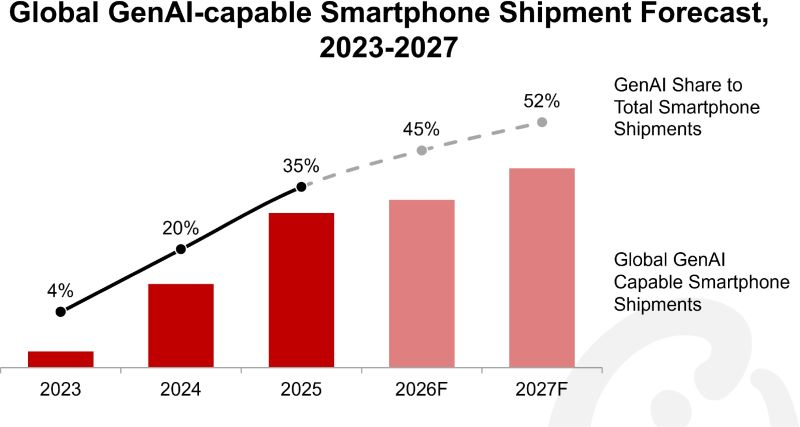
The integration of generative AI into the mobile ecosystem is accelerating at a breakneck pace. According to recent data from Counterpoint Research, the adoption trajectory shows steady growth: while smartphones with AI capabilities accounted for 36% of the market last year, that figure is expected to reach 45% this year. By next year, this metric is projected to cross the critical 52% threshold, effectively signaling the transition of generative AI from a competitive advantage to an industry baseline for any modern device.
However, this technological surge is unfolding against a backdrop of significant market contraction. Total smartphone shipments are expected to decline by 13.9% this year, dropping to 1.08 billion units—a historic low. This slump is primarily driven by acute memory shortages, which have constrained manufacturers' ability to roll out new hardware. In this climate, Apple and Samsung, leveraging their massive engineering resources and dominant market shares, have naturally emerged as the primary catalysts of the AI revolution, setting the tempo for the entire industry.
At this stage, a compelling economic disparity has emerged. For devices with a wholesale price exceeding $400, generative AI has already become the norm. Nevertheless, this feature has yet to become a primary purchase driver; consumers remain cautious, and the actual utilization of these promoted functions remains low. Parallel to this, a fundamental technical shift is occurring: the computational workload of AI agents is gradually migrating from cloud services directly to on-device resources. This transition is critical for enhancing both user privacy and response latency.
Particular attention is focused on the evolution of Siri. The updated interface already demonstrates a more nuanced contextual awareness and greater efficiency in handling daily tasks. Should a full-scale, next-generation voice interface be integrated into future iOS versions, it could catalyze a surge in demand for new iPhone models, transforming the smartphone into a true personal assistant.
At the heart of this technological arms race lies the battle between Large Language Models (LLMs). Google Gemini has essentially become the bedrock for numerous players: it is integrated into Samsung’s Galaxy AI, utilized within Siri, and serves as the foundation for various Chinese brands. Simultaneously, the Chinese market maintains a strong reliance on local models, creating unique regional nuances. The way a manufacturer orchestrates the synergy between hardware and third-party AI platforms now defines the user experience and has become the primary battlefield for consumer loyalty.
The economic context adds a layer of volatility to the situation. Because advanced AI requires expensive components, such devices dominate the premium segment. Amidst memory shortages and rising costs, budget smartphones are losing traction, which paradoxically strengthens the position of high-end models. However, even flagship owners face a harsh reality: the rising cost of memory is eroding manufacturer margins. Consequently, consumers risk paying a premium without receiving a perceptible gain in other technical specifications.
Under these conditions, the refurbished device market is gaining significant momentum, offering a viable alternative for those unwilling to overpay for hardware. The full penetration of generative AI features into the sub-$400 segment will only be possible once the memory supply chain stabilizes, making complex on-device computations accessible to the mass market.

 The Phenomenon of the Foldable iPhone Ultra