The global transition to renewable energy is confronting a fundamental barrier: the inherent instability of power generation. Conventional lithium-ion solutions are constrained by prohibitive material costs and limited storage lifecycles, rendering them insufficient for regional-scale deployment. In response, a new paradigm of thermomechanical energy storage is emerging, utilizing carbon dioxide as the working fluid. A joint venture between Energy Dome and Google in Ireland seeks to prove that industrial scalability and ecological sustainability can coexist within a single, integrated engineering system.
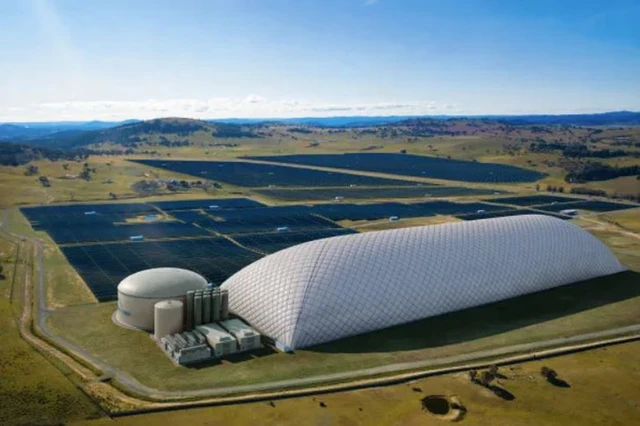
The modern energy landscape is entering a pivotal era where the primary challenge is no longer the generation of "green" electricity, but its preservation for peak demand. In County Offaly, Ireland, construction has begun on the world's first commercial energy storage system based on compressed carbon dioxide. With a capacity of 23 MW and 200 MWh, the facility will be situated on the site of a former peat-fired power plant—a move that symbolizes a profound transformation of the region's energy profile: a shift from fossil fuels to high-tech innovation.
At the heart of this technology is the "carbon battery" concept—a closed-loop thermomechanical system. Unlike chemical batteries, which rely on electrochemical potential, this system stores energy by altering the physical state of the working medium. During periods of surplus generation from solar and wind farms, the system compresses carbon dioxide, transitioning it into a dense or even supercritical state. A supercritical fluid is a unique phase of matter that possesses the density of a liquid while maintaining the high diffusivity of a gas, allowing for maximum energy accumulation efficiency.
Thermal management is the linchpin of the system's efficiency. The significant thermal energy generated during compression is not vented into the atmosphere; instead, it is captured and stored. When the grid signals a power deficit, this stored heat is used to warm the accumulated gas, causing it to expand and drive turbines under pressure, thereby converting mechanical energy back into electricity.
This approach addresses one of the industry's most pressing vulnerabilities: the reliance on critical raw materials. The Energy Dome system completely eliminates the need for lithium, cobalt, and other rare-earth metals, whose supply chains are often fraught with geopolitical risk and environmental degradation. Instead, it utilizes standard industrial components—steel, water, heat exchangers, and turbines—rendering the technology inherently scalable and easy to maintain.
The strategic choice of Ireland as a location is driven not only by the availability of land but by proximity to critical infrastructure. The plant will be integrated into the high-voltage transmission nodes serving Greater Dublin and positioned adjacent to major renewable energy parks. This allows the storage facility to function as a massive buffer, smoothing grid fluctuations and preventing the forced curtailment of wind turbines during periods of overproduction.
Google's role in this project extends far beyond simple investment. For a tech giant whose data centers and AI-driven services consume staggering amounts of power, transitioning to 24/7 carbon-free energy is a strategic priority. Traditional batteries are incapable of providing the Long-Duration Energy Storage (LDES) required to keep servers running during windless or overcast periods. Consequently, Google is betting on thermomechanical systems, simultaneously launching a similar 19 MW project in Arizona.
Scheduled for commissioning in 2028, the Irish facility will set a critical precedent for the global energy sector. It will be more than a demonstration of engineering prowess; it will serve as a full-scale commercial case study proving that carbon dioxide can be transformed from a primary atmospheric pollutant into a reliable tool for stabilizing the global energy grid.
 Drones for Cloud Cover Management Over Solar Power Plants