The disposal of lithium-ion batteries is emerging as one of the most critical bottlenecks in the transition to sustainable energy. Conventional recycling processes are often energy-intensive and destructive, reducing high-value components to raw materials via smelting and chemical leaching. Researchers at Cornell University have proposed a paradigm shift: direct electrode regeneration, a method capable of restoring batteries to near-factory performance levels. This approach fundamentally redefines waste management, pivoting from total material recovery to the targeted "rejuvenation" of individual components.
Lithium-ion battery degradation is an inevitability, an inherent consequence of the electrochemical processes at play. At the heart of this wear is the formation of the Solid Electrolyte Interphase (SEI) layer on the electrode surfaces. While a thin SEI film is essential for stable cell operation under ideal conditions, it begins to expand uncontrollably over hundreds of charge-discharge cycles. This layer evolves into a barrier that spikes internal resistance, blocks active electrode sites, and steadily erodes the device's available capacity.
Until now, the industry has addressed this issue through radical means: spent batteries were shredded, subjected to high-temperature smelting, or treated with aggressive acids to extract pure metals for the synthesis of new electrodes. However, the Direct Electrode-to-Electrode Regeneration (DEER) method, developed at Cornell University, proposes a fundamentally different paradigm. Rather than dismantling the battery's structure, researchers suggest restoring the electrodes to their pristine state.
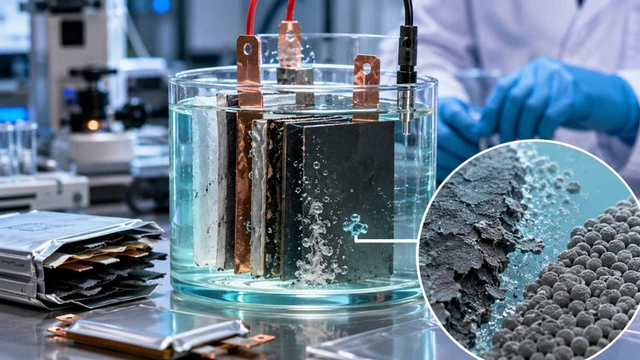
The core of the technology lies in a specialized electrochemical bath. The active agent is a solution based on 1,3-dimethyl-2-imidazolidinone (DMI)—a selective solvent capable of efficiently breaking down the specific components of the aged interphase film that have become electrochemically inactive and impede current flow. NMC (nickel-manganese-cobalt) cathodes and graphite anodes, extracted from worn-out cells, are immersed in this medium.
The results of this "rejuvenation" are striking: the mechanical integrity of the electrodes remains fully intact, with capacity recovery reaching 95%. Notably, the process leaves behind an optimized surface layer that not only stabilizes battery performance but also inhibits the further growth of detrimental deposits. Furthermore, the technology proves highly resilient to repeated use; even after a second prolonged operational cycle, a regenerated cell can recover approximately 90% of its capacity.
The economic and environmental implications of implementing DEER could be immense. Analysis conducted via the ReCell Center at Argonne National Laboratory indicates that bypassing energy-intensive pyrometallurgical and hydrometallurgical processes can reduce cell restoration costs by 56%. Beyond the direct financial gains, this approach drastically cuts water consumption, harmful emissions, and the overall energy footprint of production.
Shifting from a "destroy and rebuild" philosophy to a "clean and reuse" strategy could be a pivotal step toward establishing a truly circular economy within the energy storage sector.
 The Evolution of Solid-State Batteries: From Smartphones to Electric Vehicles