The current evolution of Large Language Models (LLMs) is defined by a fundamental paradigm shift: the transition from simple conversational chatbots to autonomous agentic systems capable of sophisticated, deep-dive research. Yet, this progression has exposed a critical bottleneck—a staggering inefficiency in compute and token utilization as task complexity scales. Redundant operations and fragmented context frequently result in token quotas, even for premium tiers, being depleted before the system can synthesize a final deliverable. The solution lies in pivoting away from monolithic prompting toward rigorously orchestrated pipelines that decouple cognitive functions.
The fundamental flaw in contemporary "Deep Research" tools lies not so much in the cost of the models themselves, but in the absence of systemic orchestration. In standard operating modes, agentic systems often exhibit chaotic behavior: dozens of virtual assistants are deployed to solve a single task, yet they frequently duplicate each other's efforts. The result is hundreds of redundant search queries and thousands of repetitive claim verifications that consume massive token volumes without guaranteeing a high-quality outcome. Experience shows that even top-tier subscriptions can be completely exhausted within half an hour of intensive work, leaving the researcher with an unfinished report and a depleted balance.
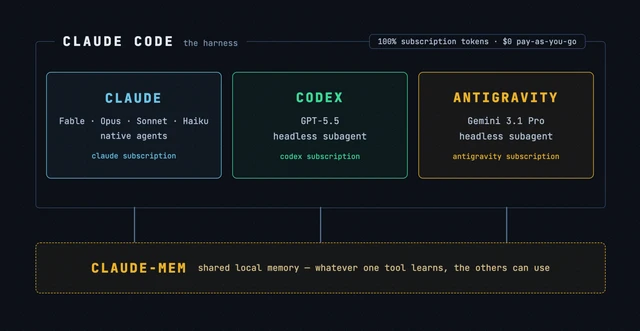
The key to overcoming this efficiency crisis is the implementation of a shared memory concept. By utilizing specialized tools such as the claude-mem plugin, developers can create a unified information layer accessible to all active agents. When search results, intermediate conclusions, and discovered sources are stored in a common registry, subsequent models no longer need to repeat the same operations. This transforms a disjointed ensemble of neural networks into a cohesive team where every participant builds upon previously acquired data, extending the system's continuous operational capacity nearly tenfold.
To achieve peak performance, it is essential to construct a hierarchical pipeline where each model occupies a strictly defined functional niche based on its cognitive capabilities and cost-efficiency. In such a structure, Claude Code assumes the role of "manager" and coordinator, orchestrating task flows and distributing the workload.
The strategic level—research planning, the decomposition of complex goals into sub-tasks, and the resolution of logical contradictions—is delegated to the most powerful models, such as Claude Fable 5. Operational information retrieval is assigned to Claude Sonnet 5, while critical fact-verification and link validation fall to Claude Opus 4.8. Routine data extraction and text formatting are handled by the most lightweight model, Claude Haiku 4.5, significantly reducing overall overhead.
To expand technical capabilities, external tools are integrated into the system: for instance, Codex (powered by GPT-5.5) is utilized for terminal interaction and code execution. To mitigate the risk of systemic errors and "hallucinations" inherent to any single model family, an independent expert based on Gemini 3.1 Pro (via Antigravity) is introduced into the pipeline. This cross-platform approach allows results to be cross-referenced across different neural architectures, ensuring the objectivity of the conclusions.
Professional pipelines place particular emphasis on quality control mechanisms. To minimize the risk of fabrication, every assertion must be strictly anchored to a primary source and accompanied by a direct quote. A critical rule is the segregation of duties: the agent that discovers information is prohibited from verifying it—validation must always be performed by another participant in the system. Only after multi-stage verification does data enter the shared knowledge base.
Ultimately, AI optimization boils down to several fundamental principles: minimizing the redundant transmission of long contexts, leveraging shared memory, and adopting a modular approach to research. Rather than issuing one monolithic prompt, tasks should be broken down into a chain of specialized stages. This ensures that expensive models are deployed only where their intellectual potential is truly indispensable, transforming token management from a mere expense into the art of efficient system engineering.
 Nvidia N1X and the New Era of Arm PCs