The convergence of retrogaming and modern display technology often sparks unconventional engineering breakthroughs. Electronic ink displays, traditionally optimized for static content, have long been deemed unviable for dynamic gaming due to their inherent latency and slow refresh rates. Yet, a recent project focused on building an E-Ink-powered Game Boy emulator demonstrates that these technical hurdles can be surmounted through rigorous hardware optimization. The result is an experiment that transforms a sluggish display into a medium for deep immersion in the nostalgic aesthetics of 8-bit consoles.
The foundation of this project is the M5Stack PaperS3—a device originally envisioned as a smart home control panel or an educational tool. At its heart lies the ESP32-S3 microcontroller, featuring a dual-core Xtensa LX7 processor clocked at 240 MHz. While this provides respectable power for its class, the primary bottleneck remained the display: standard E-Ink controllers are simply not designed for the refresh rates required for a fluid gaming experience.
To overcome this, a radical architectural shift was implemented: the stock display controller was replaced with a powerful Field Programmable Gate Array (FPGA). This allowed for a complete reimagining of the image output pipeline. Now, every pixel is treated as an independent region, and the system updates only those specific areas of the screen that have actually changed in the current frame. This approach minimizes visual artifacts and significantly enhances motion fluidity.
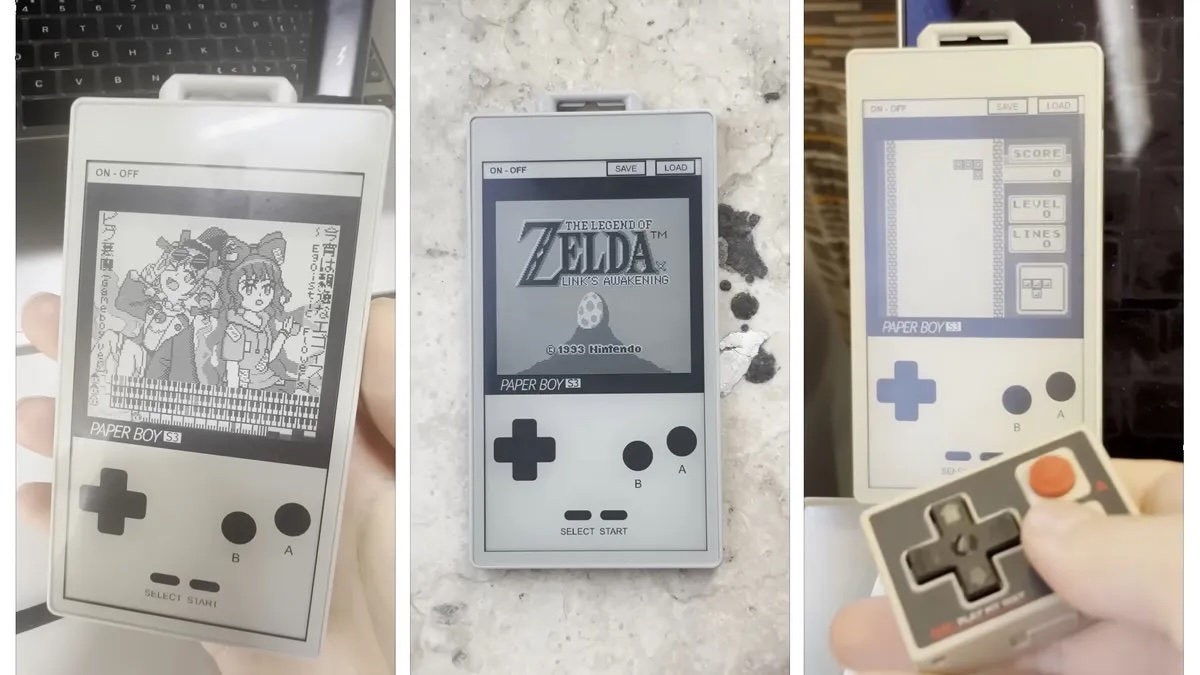
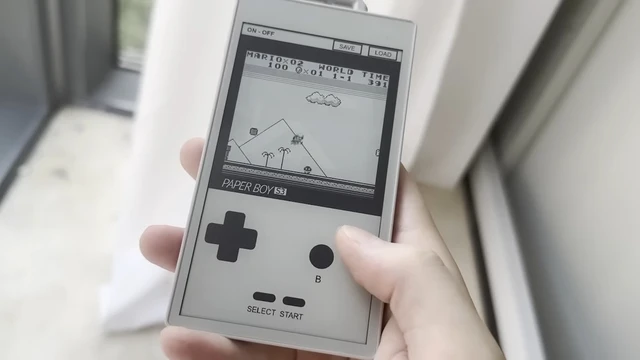
The handling of resolution is particularly noteworthy. While the original Game Boy operated at a modest 160x144 pixels, the PaperS3 boasts a density of 960x540. To fill this space while maintaining authenticity, the resolution was scaled up threefold. The remaining overhead was leveraged to implement dithering—a technique used to simulate gradients through the strategic placement of contrasting dots. This allowed the system to replicate the four iconic shades of gray that defined the Nintendo screen.
Computational load is distributed with surgical precision: the first processor core is dedicated entirely to game logic emulation, while the second is almost fully consumed by rendering processes and audio processing.
On the software side, the project relies on a modified version of CrankBoy—an emulator originally developed for the Playdate console. While most existing solutions failed to achieve full-speed performance on this hardware, this specific fork pushed the device as close as possible to the original game tempo. Audio presented an additional challenge; since the device is equipped only with a basic piezoelectric buzzer, pseudo-polyphony was employed to recreate the recognizable soundscape.
However, this visual fidelity comes at a cost to energy efficiency. E-Ink displays become incredibly power-hungry when pushed toward 60 Hz, and running both CPU cores at peak capacity reduces battery life to a minimum.
Although the PaperS3 model has been discontinued, the project remains accessible via M5Burner, allowing other enthusiasts to explore this unusual symbiosis. This aligns with a broader industry trend toward "slow gaming"; for instance, Singular 9 recently introduced the Ink Console—a handheld featuring a 7.5-inch E-Ink screen designed to merge reading and interactive entertainment into a single device.
 The Price of Acceleration: CXMT’s Rapid Push into Memory