In an era defined by pervasive digital surveillance, traditional encryption is no longer a sufficient shield; the mere act of transmitting encrypted data often acts as a beacon for scrutiny. Steganography offers a more subtle paradigm—concealing the very existence of secret information within the fabric of mundane content. A new open-source project, Conversation Steganography, elevates this classic discipline to the realm of Large Language Models (LLMs). By weaving hidden meanings into natural dialogue, it effectively camouflages suspicious cryptographic noise as harmless, everyday conversation.
Modern traffic analysis systems effortlessly identify encrypted communications by their high entropy, rendering correspondence conspicuous even when the content remains fully confidential. The remedy for this vulnerability lies in semantic masking. Enter "Conversation Stenography"—an open-source project implemented in Go under the GNU GPL v3.0 license, which leverages artificial intelligence to transform clandestine data into natural human prose.
At its core, the system relies on a synergy between complex arithmetic algorithms and the capabilities of Large Language Models (LLMs). Rather than simply encrypting a message, the service generates "cover text"—perhaps a rambling discourse on soup recipes or a casual chat about the weather—that appears entirely organic to any external observer or automated messenger filter.
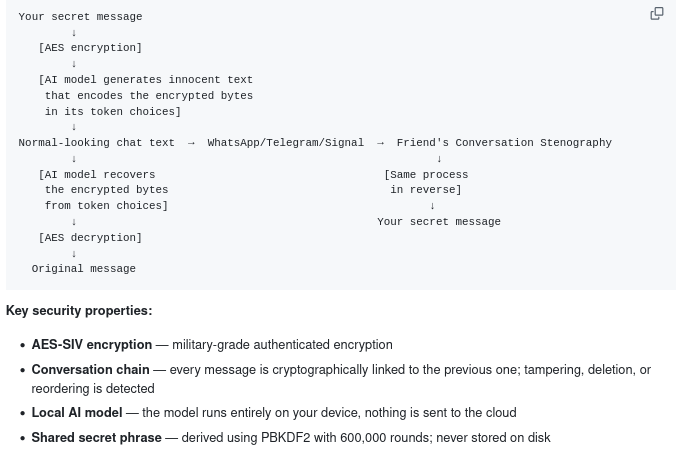
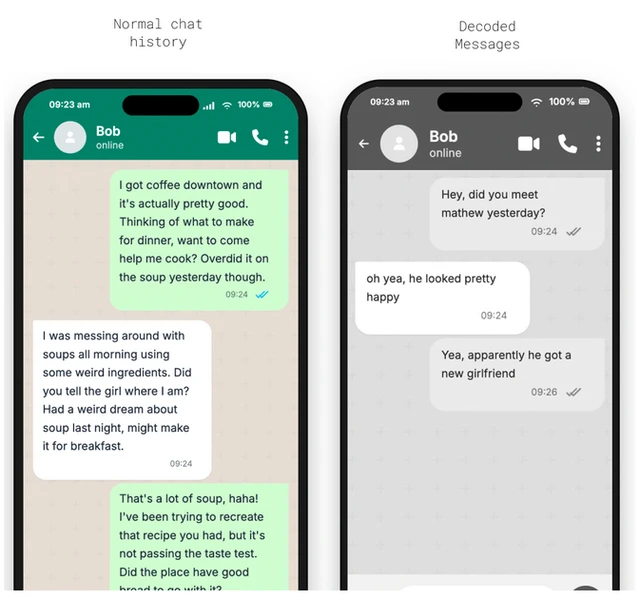
In practice, the workflow is seamless: a user inputs a specific instruction, such as "meet at the coffee shop at 15:00," and the system transmutes it into an elaborate passage about fresh basil and culinary preferences. The recipient, equipped with the corresponding software and a shared secret key, receives this text and decodes it back to its original meaning. To the messaging platform, the exchange appears as a harmless dialogue, effectively bypassing anomaly detection systems.
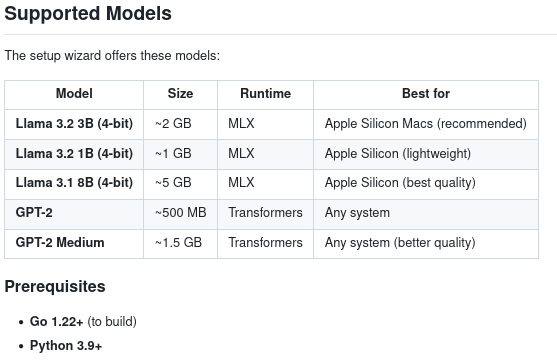
To ensure stable decryption, strict determinism is paramount. Both participants must utilize identical versions of the neural networks; the project maintains compatibility even with compact models like Llama 3 4B or GPT-2. Any discrepancy in model configuration or weight versions would result in data loss, as the algorithm relies on the precise correspondence of generated tokens.
Furthermore, the system imposes rigorous requirements on text transmission: messages must be copied byte-for-byte, eschewing autocorrect, "smart quotes," or any formatting that might alter the string structure. The sequence of messages must also be strictly maintained to preserve the integrity of the context chain.
From a cryptographic standpoint, the project adheres to proven industry standards. To ensure confidentiality and integrity, it employs AES-SIV (Synthetic Initialization Vector), which mitigates specific types of cipher attacks. The shared secret phrase undergoes intensive processing via PBKDF2-HMAC-SHA-256 with 600,000 iterations, rendering brute-force attempts practically impossible.
The message-linking mechanism is particularly noteworthy. Each new entry in the dialogue authenticates the sender, the conversation ID, and the message index, while incorporating a hash of all preceding elements in the chain. This effectively creates a "cryptographic blockchain" within the chat, preventing an adversary from covertly deleting or reordering messages.
The cornerstone of its security architecture is total localization. The AI model runs exclusively on the user's device: there are no cloud API calls, no external telemetry, and no data transmission to third-party servers. The conversation state is further shielded by AES-GCM encryption, ensuring complete isolation of secrets from the outside world and granting participants true digital sovereignty.
 Nvidia N1X and the New Era of Arm PCs