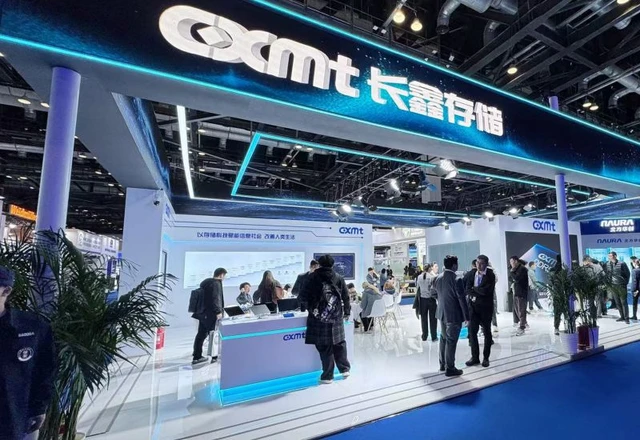
The global race for AI supremacy has shifted from the realm of algorithms to the physical reality of semiconductor manufacturing. CXMT’s market entry stands as one of the most pivotal events in the tech sector over the last decade, signaling a massive investor appetite for hardware infrastructure. This momentum underscores China's ambition to build a fully autonomous memory ecosystem, decoupled from Western restrictions. At this stage, the objective has transcended mere profitability; it is now a matter of strategic survival under the pressure of stringent export controls.
The debut of chipmaker CXMT on the Shanghai Stock Exchange sent shockwaves through the financial markets: the company's share price surged by 466%, peaking at 49 yuan. At the height of the frenzy, its market capitalization briefly eclipsed that of internet giant Tencent, hitting $547 billion. Despite a subsequent correction, CXMT has solidified its position as one of mainland China's most valuable public companies, with a valuation hovering around $490 billion.
The scale of the initial public offering (IPO) is impressive not only in terms of price action but also in the sheer volume of capital raised. By selling 6.7 billion shares, the company accumulated at least $8.5 billion. This marks the largest IPO in Asia this year and the most significant market entry in mainland China since the Agricultural Bank of China's listing back in 2010.
This aggressive investor appetite is driven by the global pivot toward generative AI. At the heart of every modern neural network is the need for lightning-fast processing of massive datasets, rendering DRAM (Dynamic Random Access Memory) chips a mission-critical resource. CXMT intends to deploy its newfound capital toward expanding production capacity and deepening R&D in memory architecture to close the technological gap with global industry leaders.
However, despite this meteoric start, CXMT remains in the shadow of the global titans. For context: SK hynix is valued at $881 billion, Micron is approaching the $1 trillion mark, and Samsung Electronics—whose semiconductor division serves as one of the three pillars of the industry—is valued at $1.1 trillion. These players are experiencing synchronous growth fueled by a chronic shortage of the high-speed memory essential for AI accelerators.
CXMT's technological trajectory is further complicated by geopolitical headwinds. Market data indicates that the company holds approximately 7.67% of the global DRAM market, operating three fabrication plants across Beijing and Hefei. Yet, the primary obstacle remains US export controls, which block access to cutting-edge lithography systems from the Netherlands-based ASML. Without these tools, producing chips at the most advanced nanometer nodes is virtually impossible. Nevertheless, Beijing's strategic mandate to establish a sovereign supply chain makes CXMT's growth both a matter of time and a state necessity.
Analysts note that the phenomenal first-day surge was amplified by a limited free float, creating a "coiled spring" effect amid high demand. Yet, beneath the financial metrics lies a deeper market shift: the memory shortage has already begun to bleed into the consumer sector. Rising component costs are forcing electronics manufacturers to hike prices on end-user devices—from laptops to gaming consoles—a trend already evident in Apple's updated pricing strategies.
The paradox of the situation reaches its zenith in the relationship between CXMT and Western corporations. Despite being on the Pentagon's blacklist due to alleged ties to China's military sector, Apple is showing a cautious interest in its products. Under intense pressure to optimize costs, Apple's leadership is exploring the possibility of procuring Chinese memory, effectively lobbying the US administration to ease restrictions to secure its own production chains.
 AMD’s Strategic Approach to the Budget Segment