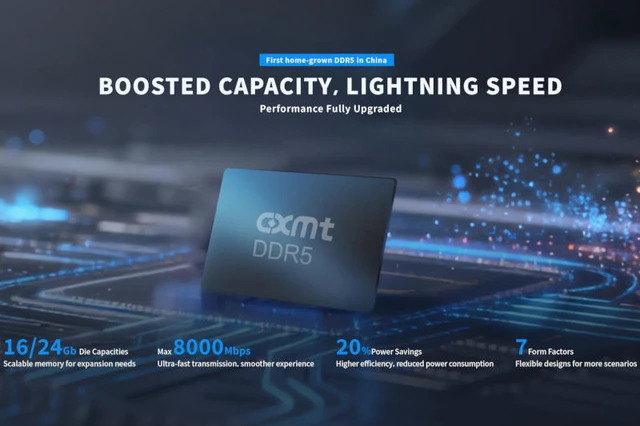
The pursuit of memory bandwidth remains a critical performance driver for modern computing systems. While the market has long been dominated by a handful of global titans, emerging Asian contenders are now aggressively disrupting the established order. Recent benchmarks conducted by MSI on the AMD AM5 platform reveal the formidable potential of dies produced by Changxin Memory Technologies—a development that paves the way for new overclocking standards and pushes the boundaries of compatibility within the consumer segment.
AMD's AM5-based platforms offer immense potential, yet realizing this performance often hinges on the stability of high-frequency memory. Against this backdrop, MSI has stepped forward with a specialized test BIOS designed specifically to optimize DDR5 modules from the Chinese manufacturer Changxin Memory Technologies (CXMT).
Previously, users were often constrained by technical or artificial frequency ceilings; CXMT-based modules typically plateaued around 6800 MHz, significantly throttling overall system bandwidth. The latest firmware update effectively dismantles these barriers, pushing memory frequencies into the 8000 to 8200 MHz range, depending on the hardware configuration and component specifications.
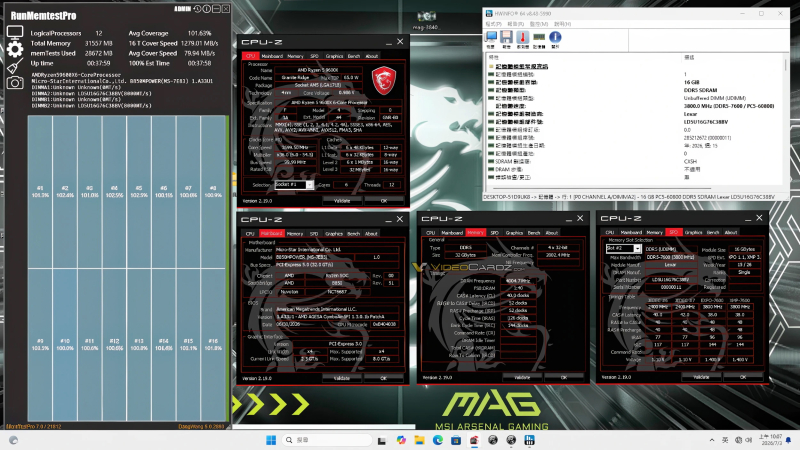
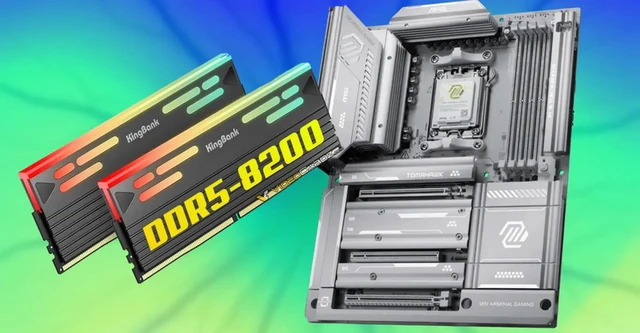
The most impressive gains were observed on motherboards featuring a two-DIMM slot topology. This layout ensures a cleaner signal with minimal interference, which, when paired with CXMT's 24Gb DRAM chips, enabled a peak frequency of 8200 MHz. Crucially, these figures are not merely theoretical or fleeting; the system successfully cleared MemTest with over 100% coverage, confirming absolute stability at these extreme speeds. Modules equipped with 16Gb chips delivered a slightly more modest, yet still formidable, result of 8000 MHz.
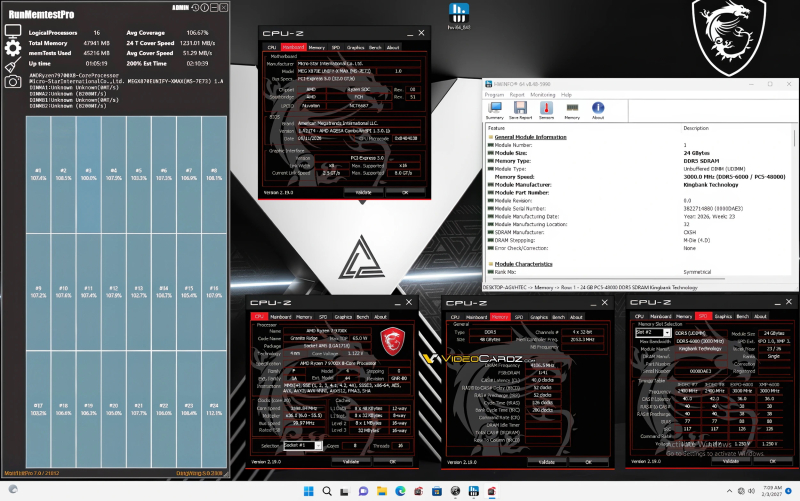
Full-sized motherboards with four DIMM slots present a more challenging scenario due to complex trace routing and electrical noise. Nevertheless, MSI engineers have managed to raise the ceiling for CXMT chips to 7200 MHz—a significant leap over the previous 6800 MHz limit.
What makes these tests particularly compelling is that MSI eschewed "golden" engineering samples in favor of retail memory kits from brands like KingBank and Lexar. This indicates that such performance is within reach for the average enthusiast. Of course, ultimate overclocking success remains subject to the "silicon lottery"—the quality of the integrated memory controller (IMC) in the specific AMD CPU and the particular motherboard revision.
The updated BIOS is currently available via official MSI community channels. While these builds are based on current stable firmware versions, they incorporate specific optimizations for Chinese memory. A broader list of supported motherboard models is expected shortly, positioning high-speed CXMT solutions as a viable alternative to traditional DDR5 brands.
 The Price of Acceleration: CXMT’s Rapid Push into Memory