The global AI surge is reshaping the semiconductor landscape, elevating memory access to a critical strategic asset. At the heart of this transformation is CXMT, the Chinese powerhouse that has successfully leveraged the global chip shortage into an unprecedented financial windfall. The company's meteoric rise represents more than just commercial victory; it is a direct challenge to the established technological status quo. Today, CXMT has emerged as a pivotal instrument in Beijing's pursuit of total digital sovereignty.
The global semiconductor market is currently navigating a period of intense turbulence, where the appetite for computational power consistently outstrips production capacity. In this climate, CXMT has emerged as one of the primary beneficiaries of the AI revolution. The results for the first half of 2026 are nothing short of phenomenal: revenue has surged nearly tenfold to 150.3 billion yuan ($22.4 billion), more than doubling the figures for the entire previous year. Even more striking is the company's pivot from losses to massive profitability, posting a net income of 77.6 billion yuan ($11.55 billion) for the period.
This financial trajectory has triggered a seismic reaction across the equity markets. Following one of the largest IPOs in the history of the Shanghai Stock Exchange—which raised 66.6 billion yuan ($9.91 billion)—CXMT's share price skyrocketed by 570%. This surge propelled the memory manufacturer past titans like Tencent in terms of market capitalization, establishing it as China's most valuable public company. Analysts at Goldman Sachs suggest that even current valuations remain conservative, projecting that net profit could climb to 361 billion yuan ($53.72 billion) by 2027.
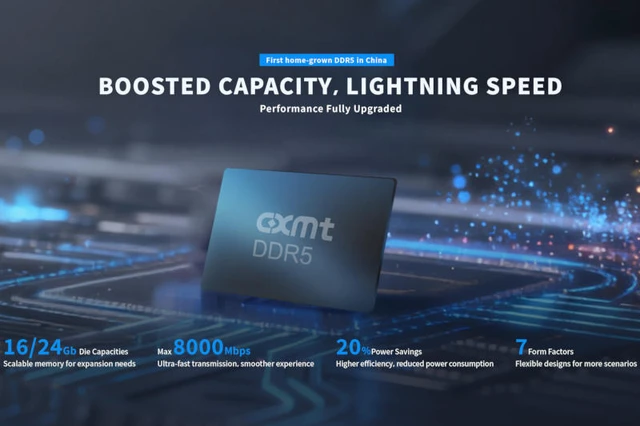
The bedrock of this growth is the acute shortage of Dynamic Random-Access Memory (DRAM), an indispensable component for the data centers powering neural networks. By pivoting rapidly to meet market demand, CXMT has secured fourth place in the global DRAM rankings. The company is not merely scaling volume but is ascending to a new technological tier: it has moved next-generation LPDDR6 memory chips into mass production while simultaneously advancing the development of High Bandwidth Memory (HBM). The latter—a stacked memory architecture—is critical for modern AI accelerators, where traditional memory solutions have become the primary data transmission bottleneck.
However, CXMT's success transcends pure economics, taking on a geopolitical dimension. The company has become the vanguard of Beijing's strategy to decouple from foreign technology and establish a self-sufficient, closed-loop electronics ecosystem within China. To achieve this, CXMT is investing aggressively in human capital and scientific research. R&D expenditures have climbed 87% to 6.86 billion yuan ($1.02 billion), while its research staff has expanded by 61%, now totaling 7,500 specialists.
The paradox of the current climate is that despite being on the U.S. Department of Defense blacklist, CXMT remains an attractive partner for global corporations. Notably, Apple is in negotiations to procure memory chips from CXMT, as well as NAND flash from another Chinese player, YMTC. This pragmatic approach by the Cupertino giant has sparked serious alarm in Washington, where calls for a total severance of ties with Chinese memory manufacturers are growing louder. Nevertheless, the market reality and CXMT's technological momentum have created a scenario where ignoring this player is becoming virtually impossible.
 Nvidia’s Technological Pragmatism in the Open-Model Race