Modern computing is, at its core, a relentless battle against thermal waste. As transistor density climbs and clock speeds soar, the heat output of flagship processors has evolved from a mere byproduct into a formidable engineering hurdle. Yet, the very energy that designers typically scramble to dissipate as rapidly as possible can, in fact, be harnessed as a source of mechanical work. A recent experiment involving a high-performance workstation vividly illustrates the latent physical potential inherent in the thermal dissipation of modern systems.
The centerpiece of this experiment is one of the most formidable offerings in the consumer segment: the AMD Threadripper 3970X. Built on the Zen 2 architecture, this die boasts immense computational headroom; its 32 cores and 64 threads are capable of tackling the most demanding workloads, but they simultaneously transform the processor's surface into an intense source of thermal radiation. To push the system to its limits and ensure a steady flow of energy, Cinebench was deployed—a synthetic benchmark designed to drive every core to its absolute peak.
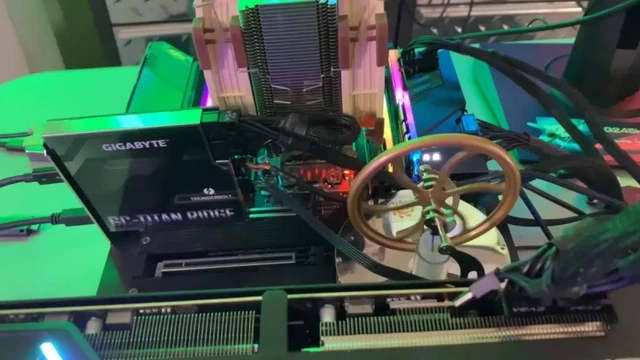
To convert this heat into kinetic motion, a miniature Stirling engine was placed directly on the motherboard within the CPU's thermal zone. As a result of the resulting thermal gradient, a portion of the heat energy began transforming into mechanical work, triggering the rhythmic stroke of the piston and the rotation of the flywheel.
The operating principle of the Stirling engine, patented in the early 19th century, serves as an elegant masterclass in thermodynamics. Unlike internal combustion engines, it utilizes a closed cycle: the working fluid (gas or liquid) moves within a sealed chamber. Energy is extracted through the periodic heating and cooling of this fluid, creating sharp pressure differentials that drive the piston. Such low-temperature models are frequently used for educational purposes, as they can be activated by something as simple as the heat from a cup of coffee.
From a technical standpoint, this experiment does not propose a new cooling methodology. Mounting an engine atop a processor does not significantly reduce the die's overall temperature, nor does it replace a dedicated thermal management system. However, the true value of this exercise lies in its clarity.
In an era where most users interact with computers through abstract interfaces and lines of code, such a demonstration brings us back to fundamental physics. It serves as a reminder that every digital process carries a material cost measured in joules, and that the heat we typically dismiss as a "waste product" is, in fact, a potent physical resource capable of driving a real-world mechanism.
 The Price of Acceleration: CXMT’s Rapid Push into Memory