The shift from cloud-based services toward local neural network execution is emerging as a defining trend in personal computing. The imperatives of data privacy and ultra-low latency are necessitating a fundamental paradigm shift in hardware architecture. In response, Chuwi has unveiled the UniBox series, a line that reimagines the potential of the mini-PC, transforming these compact devices into fully capable AI workstations. These machines demonstrate how high resource density can be successfully integrated into an ultra-compact form factor.
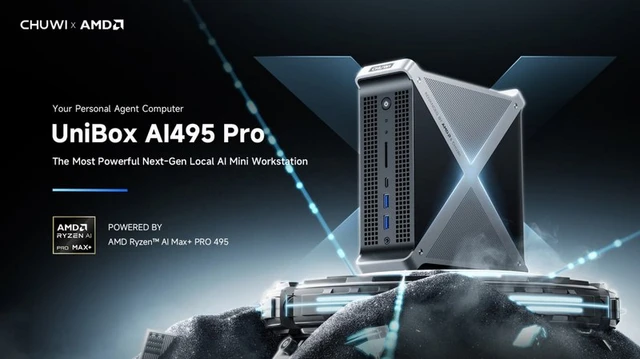
For too long, the AI hardware landscape has been polarized between two extremes: cumbersome server racks packed with GPU arrays on one end, and limited consumer laptops on the other. The arrival of the UniBox AI495 Pro from Chuwi represents a concerted effort to bridge this divide. At its core lies the Gorgon Halo platform, powered by the AMD Ryzen AI Max+ Pro 495 processor based on the Zen 5 architecture. With 16 cores and 32 threads clocking up to 5.2 GHz, this chip provides the necessary computational bedrock for demanding analytical workloads.
The graphical powerhouse is the Radeon 8065S accelerator, built on RDNA 3.5. Featuring 40 compute units and clock speeds reaching 3 GHz, the system can comfortably handle modern AAA titles at 1080p; however, gaming is a secondary consideration here. The primary objective of this hardware is to support massive computations, where the GPU operates in tight synergy with the CPU.
The true architectural triumph of the UniBox AI495 Pro is its memory management. The device implements unified LPDDR5X-8533 memory with capacities up to 192 GB. Thanks to a 256-bit bus, bandwidth reaches 273 GB/s—a critical factor when moving vast datasets within neural networks. Particular attention has been paid to resource flexibility: up to 160 GB of the total memory pool can be allocated directly as video memory (VRAM).
This approach enables the local execution of Large Language Models (LLMs) with up to 300 billion parameters, provided 4-bit quantization is used. Quantization—the process of reducing the precision of model weights—allows for a radical reduction in memory requirements without significant degradation in output quality, transforming the UniBox into a professional-grade tool for AI developers and researchers.
The platform's total AI throughput is rated at 131 TOPS. A significant portion of this power (up to 55 TOPS) is delivered by the XDNA 2 dedicated neural processing unit (NPU). This not only accelerates specific machine learning tasks but also ensures full compatibility with Microsoft Copilot+ PC standards.
Despite its formidable internals, the system's physical footprint remains minimalist. The 2.9-liter chassis (209.6 × 209.6 × 67 mm) occupies little desk space while providing enterprise-grade connectivity. For networking, it features dual 10 Gbps Ethernet ports, and for those who find the integrated graphics insufficient, an OCuLink port is provided for external discrete GPU expansion. Connectivity is rounded out by two USB4 ports (40 Gbps), Wi-Fi 7, and Bluetooth 5.4. The entire system is powered via a 240W external adapter.
Alongside the flagship, a more accessible version has been introduced: the UniBox AI395. It is based on the Ryzen AI Max+ 395 processor with an identical core count (16C/32T), though it features slightly lower clock speeds (up to 5.1 GHz) and Radeon 8060S graphics. Maximum memory is capped at 128 GB of LPDDR5X-8000, with up to 96 GB assignable to the GPU. Total AI performance stands at 126 TOPS. Thanks to support for MoE (Mixture of Experts) architecture and low-bit quantization, this model is capable of handling neural networks with up to 235 billion parameters.
The technical specifications for both models are completed by a robust storage system: three M.2 2280 PCIe 4.0 slots allow for the installation of up to three 2 TB SSDs, providing the necessary capacity to house massive model weights and datasets.
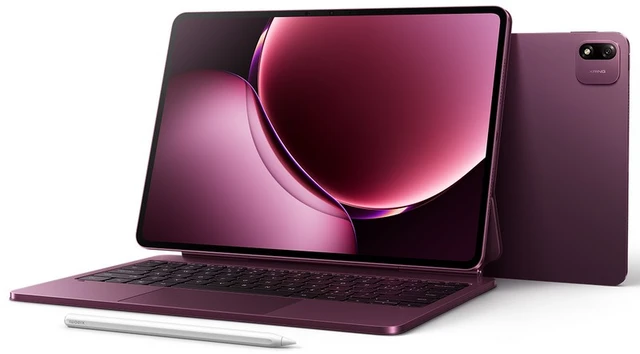 Power and Poise: The Xiaomi Pad 9 Pro Max